Discuss the transmission dynamics of respiratory tract infections in densely populated urban settings. Propose effective public health strategies for their prevention.
In short
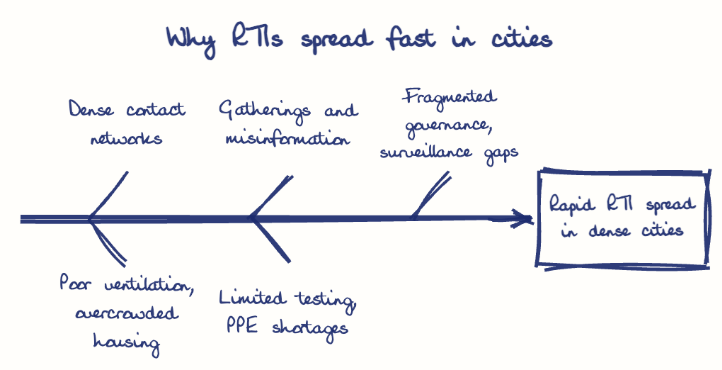
Respiratory infections spread fast in dense cities through crowded contact networks, poorly ventilated housing, crowded markets and transport, and habits like spitting, while weak surveillance delays containment. Prevention needs integrated surveillance, better housing and ventilation, community health education and wider testing, especially in growing cities like Visakhapatnam.
Model answer
Ghissu Editorial · Verified 4 Oct 2026 · 261 words
Fragmented Health Governance
In Andhra Pradesh, disjointed municipal and state health systems and weak public-private partnerships impede coordinated RTI surveillance and response, limiting comprehensive outbreak management.
Surveillance and Community Engagement Gaps
The absence of integrated multi-disciplinary surveillance and limited community participation reduce early detection and compliance with preventive measures in urban slums.
Integrated Surveillance Systems
Real-time, multi-sectoral data integration from community health workers and private clinics can enable early outbreak detection in urban hotspots, facilitating targeted containment.
Urban Infrastructure Improvements
Investments in affordable housing, improved ventilation, and sanitation in rapidly urbanizing areas like Andhra Pradesh reduce environmental transmission risks and improve living conditions.
Community Engagement and Testing Expansion
Tailored health education campaigns leveraging local leaders and digital platforms, combined with scaling up rapid antigen and antibody testing, ensure timely diagnosis and promote preventive behaviors in vulnerable populations.
Unified Urban Health Governance
Developing cohesive epidemic preparedness models integrating municipal, state, and private actors in Andhra Pradesh is essential for coordinated response and resource optimization.
Technology-Driven Surveillance
AI-based contact tracing and digital tools can efficiently map transmission networks and predict outbreak clusters in dense urban localities, enhancing proactive interventions.
This model answer is indicative and the model can make mistakes; please verify key facts independently.
Practise this question
1Get the answer sheet
Sized for this question.
2Write your answer
Timed, by hand.
3Get it marked
Your score and what to fix.
This chapter in the exam
Human diseases; genetic engineering basics; biotechnology in agriculture; vaccines54 questions
Asked in 8 of 8 sittings since 2008
Most tested: Vaccines and immunisation, alongside GM crops/biotech agriculture.
- 2025Examine how urban infrastructure influences the implementation of preventive measures during microbial disease outbreaks. Suggest technology-driven solutions.
- 2025Define genetic engineering. Explain its applications in agriculture and medicine.
All 54 questions, sorted by sub-topic, with model answers and practice.
Question from the official APPSC Group-I Mains 2025 paper. Answer written by Ghissu's engine and checked against our editorial standards. Found an error? Tell us and we correct it within 48 hours.