Discuss the Agricultural research in India mentioning its linkages. Describe the research and educational activities in the field of agriculture, animal husbandry and fisheries.
In short
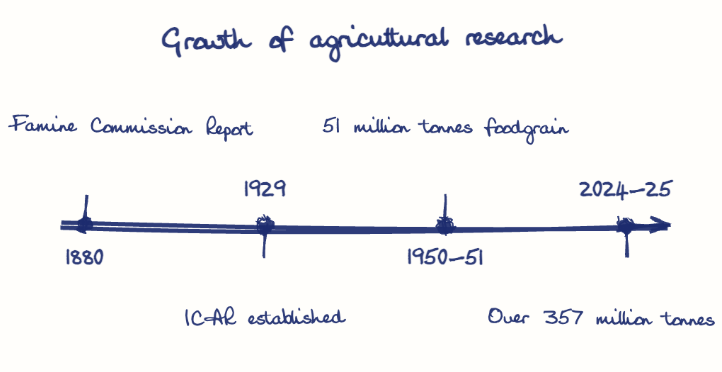
Agricultural research in India, led by ICAR (1929) and over 70 agricultural universities, links laboratories to farmers through KVKs and ATMA and covers crops, livestock and fisheries. It helped raise foodgrain output from 51 million tonnes in 1950-51 to over 357 million tonnes in 2024-25.
Model answer
Ghissu Editorial · Verified 4 Oct 2026 · 257 words
Institutional Foundation
ICAR, founded in 1929, alongside 70+ Agricultural Universities, forms one of the world’s largest agricultural research systems, originating from the 1880 Famine Commission Report. This network has expanded research capacity and outreach nationwide.
Productivity and Economic Impact
Research boosted foodgrain production from 51 million tonnes (1950-51) to over 357 million tonnes (2024-25), with R&D investments yielding higher returns than fertiliser subsidies. The Green Revolution’s introduction of high-yielding varieties and improved irrigation exemplifies this success.
Extension and Policy Linkages
KVKs and ATMAs facilitate technology transfer; In Andhra Pradesh, KVKs have played a vital role in adapting technologies to local conditions. Schemes like Pradhan Mantri Fasal Bima Yojana2 and Soil Health Card Scheme link research to sustainable farming and risk mitigation.
Livestock and Fisheries Focus
Research targets indigenous breed conservation, disease control, and vaccine development; fisheries research supports coastal aquaculture expansion, crucial for states like Andhra Pradesh with its 974 km coastline.
Funding and Innovation
Boost public-private R&D investment in biotechnology, GIS, and climate-resilient crops tailored to regional needs. Enhancing interdisciplinary research and attracting youth to agriculture remain priorities.
This model answer is indicative and the model can make mistakes; please verify key facts independently.
Practise this question
1Get the answer sheet
Sized for this question.
2Write your answer
Timed, by hand.
3Get it marked
Your score and what to fix.
This chapter in the exam
Science, Technology & Innovation: policies, institutions, achievements20 questions
Asked in 7 of 8 sittings since 2008
Most tested: Science and technology policy and mission-mode institutions
- 2025Evaluate the impact of Internet of Things (IoT) technologies on the automation of household systems. Illustrate how everyday tasks have evolved due to IoT innovations.
- 2025Which are the major scientific institutes located in Andhra Pradesh? Discuss the role of IISER Tirupati in the scientific and educational development of the state.
All 20 questions, sorted by sub-topic, with model answers and practice.
Question from the official APPSC Group-I Mains 2011 paper. Answer written by Ghissu's engine and checked against our editorial standards. Found an error? Tell us and we correct it within 48 hours.