Discuss the sources, impacts and control measures of Marine pollution.
In short
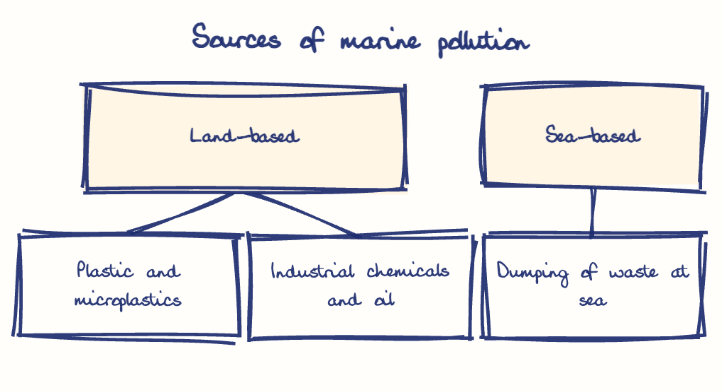
Marine pollution comes from plastics, industrial effluents carrying mercury and pesticides, sewage and oil spills, causing coral bleaching, dead zones and falling fish stocks that threaten fisherfolk on coasts like Andhra Pradesh's 974 km shoreline. It is controlled through CRZ Notifications, MARPOL, the 2022 single-use plastic ban and coastal monitoring.
Model answer
Ghissu Editorial · Verified 4 Oct 2026 · 261 words
Regulatory Instruments
Coastal Regulation Zone (CRZ) Notifications under the Environment Protection Act, 1986, regulate coastal activities; India adheres to MARPOL and UNCLOS, empowering coastal pollution control in Andhra Pradesh’s coastal districts.
National Campaigns
The 2022 Single-Use Plastic Ban and UNEP’s Clean Seas Campaign target plastic reduction, with implementation efforts in Andhra Pradesh’s coastal towns.
Plastic and Microplastic Pollution
Studies record rising plastic discharge along the Chennai coast, signaling similar threats to Andhra Pradesh’s ports and fisheries; microplastics contaminate seafood, posing health risks.
Governance Gaps
Weak enforcement of CRZ and plastic bans, limited technology, and financial constraints hamper pollution control in Andhra Pradesh’s coastal zones.
Ecological Consequences
Pollution causes coral bleaching, fish stock decline, and dead zones, threatening livelihoods of over four million fisherfolk nationally, including Andhra Pradesh’s coastal communities.
Enhanced Monitoring
Expand networks like COMAPS along Andhra Pradesh’s coast for real-time pollution data.
Waste Management and Awareness
Scale up plastic recycling and community campaigns in Andhra Pradesh.
Institutional Strengthening
Create a coastal pollution task force in Andhra Pradesh for enforcement of CRZ and plastic bans.
Sustainable Blue Economy
Promote eco-friendly aquaculture and green maritime transport1 in Visakhapatnam and other ports.
This model answer is indicative and the model can make mistakes; please verify key facts independently.
Practise this question
1Get the answer sheet
Sized for this question.
2Write your answer
Timed, by hand.
3Get it marked
Your score and what to fix.
This chapter in the exam
Pollution & solid waste; global issues; environmental legislation; disaster management policy; agricultural revolutions43 questions
Asked in 8 of 8 sittings since 2008
Most tested: Solid waste management and pollution-control legislation
- 2025What are the key principles of Integrated Solid Waste Management (ISWM)? Discuss the role of waste hierarchy in ISWM.
- 2025Define global warming, and differentiate it clearly from climate change. Explain the key natural and human-induced causes of global warming and briefly discuss which factors are currently dominant in driving global temperature rise.
All 43 questions, sorted by sub-topic, with model answers and practice.
Question from the official APPSC Group-I Mains 2011 paper. Answer written by Ghissu's engine and checked against our editorial standards. Found an error? Tell us and we correct it within 48 hours.