Explain Urban Governance and role of community in Municipal Solid Waste Management.
In short
Urban local bodies govern solid waste management under the 74th Amendment and the Solid Waste Management Rules, 2016, while communities make it work through source segregation, informal recycling, awareness and monitoring. In Andhra Pradesh, ULBs generate about 6,890 tons daily, yet only 4 of 123 had sanitary landfills in 2022.
Model answer
Ghissu Editorial · Verified 4 Oct 2026 · 262 words
Constitutional and Institutional Framework
The 74th Amendment3 mandates ULBs to manage MSWM; however, CAG audits reveal gaps in Andhra Pradesh’s ULBs, with only 4 of 123 having sanitary landfills and weak enforcement of the Solid Waste Management Rules, 2016. This reflects infrastructural and capacity deficits limiting effective waste disposal.
Policy and Steering Committees
State High Powered Steering Committees and State Level Advisory Bodies guide implementation, while the CPCB monitors compliance with the rules across states. These frameworks aim to enhance coordination and compliance but require stronger enforcement.
Source Segregation and Informal Sector
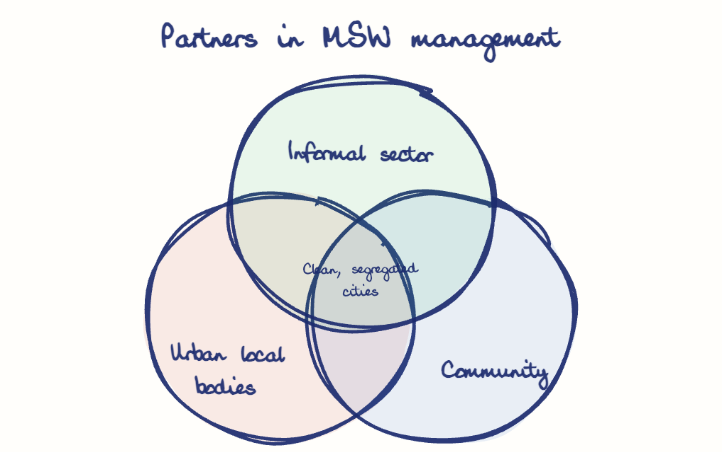
Community participation is vital for source segregation; audits show actual segregation at 75% despite claims of 98.17%4. Informal waste pickers play a key role but need formal integration and support through training and social security to improve recycling efficiency.
Capacity Building and Legacy Waste
Strengthening ULB capacities through training and increased budgets, alongside addressing legacy waste via initiatives like Lakshya Zero Dumpsite5 under SBM-Urban 2.0, is essential for sustainable management.
This model answer is indicative and the model can make mistakes; please verify key facts independently.
Practise this question
1Get the answer sheet
Sized for this question.
2Write your answer
Timed, by hand.
3Get it marked
Your score and what to fix.
This chapter in the exam
Pollution & solid waste; global issues; environmental legislation; disaster management policy; agricultural revolutions43 questions
Asked in 8 of 8 sittings since 2008
Most tested: Solid waste management and pollution-control legislation
- 2025What are the key principles of Integrated Solid Waste Management (ISWM)? Discuss the role of waste hierarchy in ISWM.
- 2025Define global warming, and differentiate it clearly from climate change. Explain the key natural and human-induced causes of global warming and briefly discuss which factors are currently dominant in driving global temperature rise.
All 43 questions, sorted by sub-topic, with model answers and practice.
Question from the official APPSC Group-I Mains 2011 paper. Answer written by Ghissu's engine and checked against our editorial standards. Found an error? Tell us and we correct it within 48 hours.