Give a brief description of GM crops and explain the regulations and concerns associated with the release of a Genetically Modified crop.
In short
GM crops are plants altered with foreign genes for traits like pest resistance and herbicide tolerance, released in India under the Environment Protection Act, 1986 and its 1989 Rules, with GEAC approving environmental release. Key concerns are transgene flow, health and pollinator effects, and litigation such as the Bt-brinjal moratorium.
Model answer
Ghissu Editorial · Verified 4 Oct 2026 · 252 words
Comprehensive Legal Structure
India’s Environment Protection Act, 1986, and the 1989 Rules on hazardous microorganisms and genetically engineered organisms regulate GM crops, covering all stages from research to commercial release.
Key Regulatory Bodies
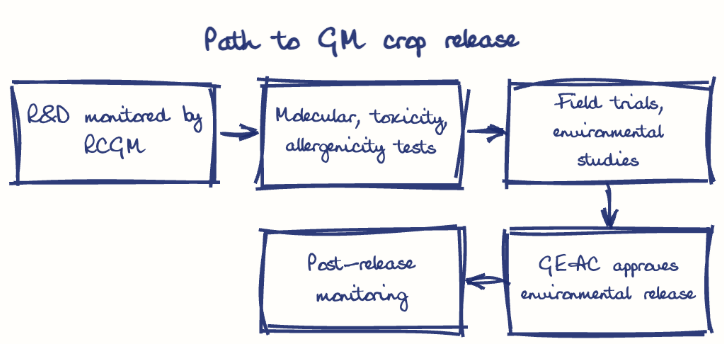
The Genetic Engineering Appraisal Committee (GEAC) under the Ministry of Environment approves environmental release, while the Review Committee on Genetic Manipulation (RCGM) under the Department of Biotechnology oversees research and development activities involving GM organisms.
Regulatory and Market Hurdles
The moratorium on Bt-brinjal and ongoing Supreme Court cases on GM mustard’s environmental release delay commercialization, limiting farmer access to improved varieties. Public skepticism and trade barriers, including stringent labeling and import restrictions, complicate market acceptance and adoption, notably in Andhra Pradesh where cotton cultivation is significant.
Support Monitoring and Innovation
Establish robust post-release environmental and health impact monitoring systems to address concerns and adapt policies based on evidence. Invest in indigenous biotechnology research within Andhra Pradesh’s agricultural universities to develop locally adapted GM and gene-edited crops addressing regional challenges like drought and pest resistance.
This model answer is indicative and the model can make mistakes; please verify key facts independently.
Practise this question
1Get the answer sheet
Sized for this question.
2Write your answer
Timed, by hand.
3Get it marked
Your score and what to fix.
This chapter in the exam
Human diseases; genetic engineering basics; biotechnology in agriculture; vaccines54 questions
Asked in 8 of 8 sittings since 2008
Most tested: Vaccines and immunisation, alongside GM crops/biotech agriculture.
- 2025Discuss the transmission dynamics of respiratory tract infections in densely populated urban settings. Propose effective public health strategies for their prevention.
- 2025Examine how urban infrastructure influences the implementation of preventive measures during microbial disease outbreaks. Suggest technology-driven solutions.
All 54 questions, sorted by sub-topic, with model answers and practice.
Question from the official APPSC Group-I Mains 2011 paper. Answer written by Ghissu's engine and checked against our editorial standards. Found an error? Tell us and we correct it within 48 hours.