(i) Differentiate between wild and domestic animals. (ii) Give an overview of how animals are exploited in medical research.
In short
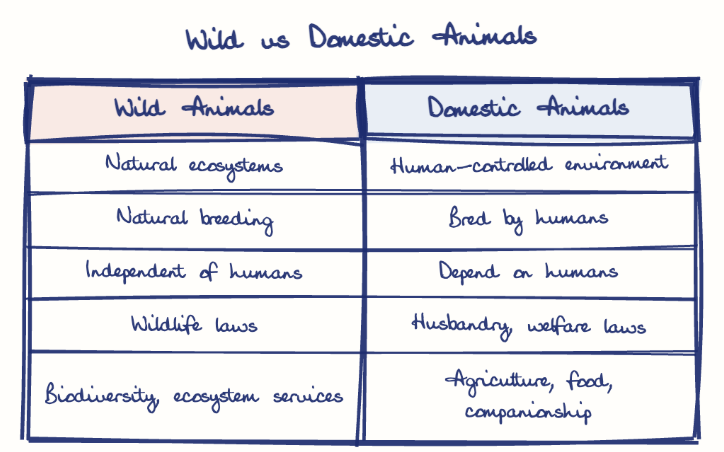
Wild animals live independently in natural ecosystems and are protected for their ecological value, while domestic animals are bred to depend on humans for food, work and companionship. Medical research uses mice, rats, rabbits and primates for drug and vaccine testing, under CPCSEA oversight and the 3Rs.
Model answer
Ghissu Editorial · Verified 4 Oct 2026 · 332 words
Habitat and Human Interaction
Wild animals live and reproduce naturally, maintaining ecosystems, while domestic animals depend on humans for food and breeding, as shown by the Livestock Census1 and Integrated Sample Survey data. Domestic animals are adapted to human-controlled environments and bred for specific purposes like food, labor, or companionship.
Legal and Economic Roles
Wild animals receive protection under wildlife laws and programs like Project Elephant2, which safeguards elephant populations and corridors, whereas domestic animals support agriculture and nutrition, with India producing 239.30 million tonnes of milk in 2023-24. Domestic animals contribute significantly to rural livelihoods and the national economy.
Ethical and Regulatory Frameworks
Animal testing is vital for drug safety, governed by CPCSEA guidelines to minimize pain, with anesthesia and humane endpoints used; however, enforcement challenges persist, especially in rural areas. The Committee for the Purpose of Control and Supervision of Experiments on Animals (CPCSEA) ensures standards but faces resource and awareness limitations.
Balancing Conservation and Livelihoods
Andhra Pradesh’s aquaculture and livestock sectors face conflicts between economic needs and wildlife habitat protection, including elephant corridors. Expansion of domestic animal farming risks habitat encroachment and human-wildlife conflicts.
This model answer is indicative and the model can make mistakes; please verify key facts independently.
Practise this question
1Get the answer sheet
Sized for this question.
2Write your answer
Timed, by hand.
3Get it marked
Your score and what to fix.
This chapter in the exam
Biotechnology & Nanotechnology: scope, ethics, genetic engineering, biodiversity, fermentation, immuno-diagnosis50 questions
Asked in 8 of 8 sittings since 2008
Most tested: Biodiversity and biotechnology governance/ethics, especially conservation, GMOs, and applied public-health biotech.
- 2025Trace the evolution of India's National Biotechnology Development Strategy (NBDS) and discuss its key objectives. Critically evaluate its impact on the growth of the biotechnology sector in India.
- 2025Analyze the potential of plant-derived biopharmaceuticals in promoting sustainable healthcare. Explain how the application of green pharmacy principles can help minimize environmental harm at each stage of the pharmaceutical lifecycle.
All 50 questions, sorted by sub-topic, with model answers and practice.
Question from the official APPSC Group-I Mains 2011 paper. Answer written by Ghissu's engine and checked against our editorial standards. Found an error? Tell us and we correct it within 48 hours.