(i) Of late there is lot of public resistance towards the establishment of coal based power plants. Comment. (ii) Discuss the reasons for the sparse use of renewable resources in India
In short
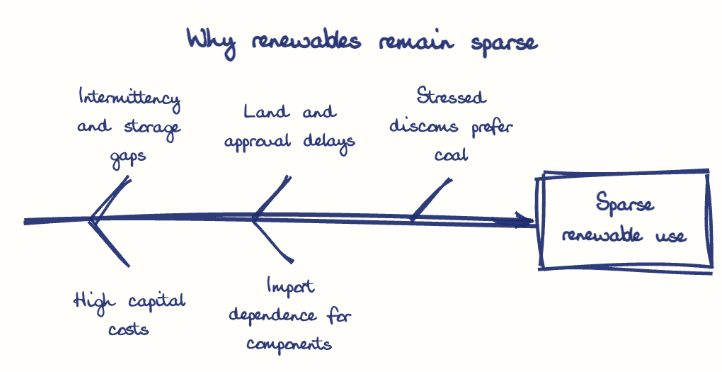
Public resistance to coal power plants stems from air pollution, health harm, land loss and displacement, as in the violent 2010-11 Sompeta and Kakarapalli protests in Srikakulam. Renewables remain under-used because of intermittency, limited storage, high upfront costs, land hurdles, import dependence and discoms preferring cheaper coal contracts.
Model answer
Ghissu Editorial · Verified 4 Oct 2026 · 251 words
Environmental and Displacement Issues
Coal plants cause pollution and health risks, fueling resistance near Visakhapatnam; protests at Sompeta and Kakarapalli in Srikakulam showed fears of losing wetlands, farmland and livelihoods.
Policy Shifts and Community Activism
Renewable Purchase Obligations and incentives discourage coal expansion; increased environmental awareness empowers communities to oppose coal projects.
Land and Technology Constraints
Land acquisition complexities and dependence on imported components, mainly from China, slow renewable deployment and deter investment.
Coal’s Role and DISCOMs’ Preferences
Coal remains crucial for energy security and employment; financially stressed DISCOMs prefer cheaper coal contracts over renewables despite mandates.
Uneven Renewable Uptake
Renewables gain traction in rural areas like Andhra Pradesh’s rural solar initiatives but urban adoption lags due to cost and awareness gaps.
Infrastructure and Policy Reforms
Invest in grid storage, simplify land acquisition, promote domestic renewable manufacturing, and expand financing and carbon credit schemes to boost clean energy.
This model answer is indicative and the model can make mistakes; please verify key facts independently.
Practise this question
1Get the answer sheet
Sized for this question.
2Write your answer
Timed, by hand.
3Get it marked
Your score and what to fix.
This chapter in the exam
Energy: needs, resources, policy; Nuclear programme and policy24 questions
Asked in 8 of 8 sittings since 2008
Most tested: Renewable energy transition in India, especially solar/clean energy and barriers to large-scale adoption.
- 2025Differentiate between conventional and non-conventional energy resources. Explain their relevance in India's energy sector.
- 2023What is the current scenario of renewable power generation in India ? Discuss the factors responsible for the growing focus and shift towards Renewable energy.
All 24 questions, sorted by sub-topic, with model answers and practice.
Question from the official APPSC Group-I Mains 2011 paper. Answer written by Ghissu's engine and checked against our editorial standards. Found an error? Tell us and we correct it within 48 hours.