What do you understand by a vaccine? Describe the journey of development from conventional to modern day (Recombinant vaccines).
In short
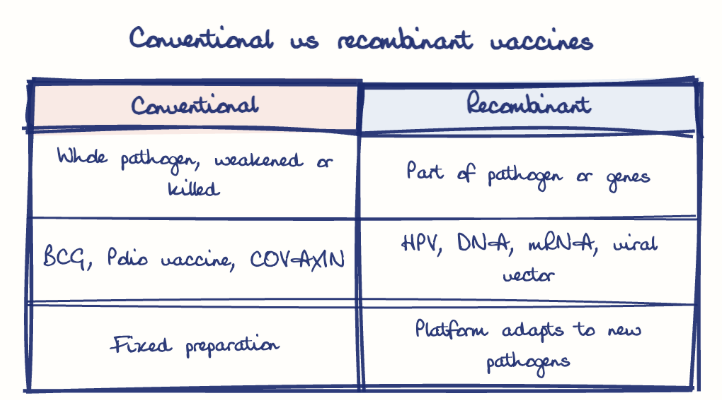
A vaccine is a biological preparation that builds adaptive immunity by exposing the body to a weakened, killed or partial pathogen or its genetic material. Development moved from Jenner's smallpox vaccine (1796) and whole-pathogen vaccines to recombinant sub-unit vaccines like hepatitis B, and now to DNA and mRNA platforms.
Model answer
Ghissu Editorial · Verified 4 Oct 2026 · 270 words
India’s Manufacturing Strength
Serum Institute and Bharat Biotech are global leaders, supported by government initiatives like the COVID Suraksha Mission to boost indigenous vaccine R&D. Their capacity enabled rapid COVID-191 vaccine development and mass production, showcasing India’s growing vaccine ecosystem.
Clinical Trials and Hesitancy
Vaccine development requires phased trials; India adopted emergency use authorisation during COVID-19. Despite expanded coverage, hesitancy remains, especially for HPV vaccines. India’s nationwide HPV vaccination drive2 targets 11.5 million girls to reduce cervical cancer and address social resistance. Public education and community engagement are critical to overcoming these barriers.
Surveillance and Future Directions
Continuous variant monitoring is vital; integration challenges exist. Strengthening surveillance, boosting R&D investment, and expanding public awareness, especially in Andhra Pradesh’s rural districts, are key to improving vaccine uptake. Initiatives like the One Health Mission aim to integrate human and animal disease surveillance for early threat detection.
This model answer is indicative and the model can make mistakes; please verify key facts independently.
Practise this question
1Get the answer sheet
Sized for this question.
2Write your answer
Timed, by hand.
3Get it marked
Your score and what to fix.
This chapter in the exam
Human diseases; genetic engineering basics; biotechnology in agriculture; vaccines54 questions
Asked in 8 of 8 sittings since 2008
Most tested: Vaccines and immunisation, alongside GM crops/biotech agriculture.
- 2025Discuss the transmission dynamics of respiratory tract infections in densely populated urban settings. Propose effective public health strategies for their prevention.
- 2025Examine how urban infrastructure influences the implementation of preventive measures during microbial disease outbreaks. Suggest technology-driven solutions.
All 54 questions, sorted by sub-topic, with model answers and practice.
Question from the official APPSC Group-I Mains 2011 paper. Answer written by Ghissu's engine and checked against our editorial standards. Found an error? Tell us and we correct it within 48 hours.