Write on (i) Communications and remote sensing (ii) Influence of Information Technology on Indian Rural Sector.
In short
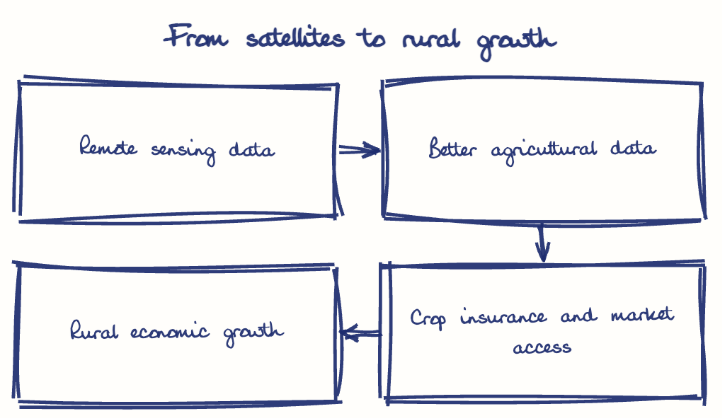
Communications and remote sensing, led by ISRO's Bhuvan portal and 473 Village Resource Centres, support crop insurance, flood assessment and watershed planning in rural India. IT has transformed the rural sector through eNAM, telemedicine, digital land records and BharatNet, though only 28% of rural women use the internet.
Model answer
Ghissu Editorial · Verified 4 Oct 2026 · 260 words
ISRO’s Remote Sensing Applications
ISRO’s Bhuvan portal aids flood damage assessment and precision agriculture, supporting schemes like Pradhan Mantri Fasal Bima Yojana1 (PMFBY). It also facilitates data-driven decision-making in rural resource management.
Digital Infrastructure2 Expansion
BharatNet has connected over 2.15 lakh Gram Panchayats with optical fibre, enhancing internet access in Andhra Pradesh and facilitating e-governance. This connectivity supports Village Resource Centres that empower rural communities with geospatial data and digital services.
Agricultural Market Access and Healthcare
eNAM enables farmers in Andhra Pradesh to access real-time prices and connect directly with markets, improving incomes. The Ayushman Bharat Digital Mission extends healthcare via telemedicine and digital health records, increasing access in remote villages.
Digital Divide and Infrastructure Gaps
Rural internet penetration is 60.46%3, with only 28% of rural women online; power supply and digital literacy remain challenges in Andhra Pradesh. Additionally, limited last-mile connectivity and gender disparities restrict the full benefits of IT in rural empowerment.
Promote Digital Literacy
Target women and marginalized groups in rural Andhra Pradesh through focused programs like PMGDISHA to bridge the digital divide and enhance inclusive participation.
This model answer is indicative and the model can make mistakes; please verify key facts independently.
Practise this question
1Get the answer sheet
Sized for this question.
2Write your answer
Timed, by hand.
3Get it marked
Your score and what to fix.
This chapter in the exam
Information and Communication Technology (ICT)24 questions
Asked in 8 of 8 sittings since 2008
Most tested: E-governance and digital public service delivery
- 2025Discuss the evolution of e-governance in India, highlighting key initiatives. Analyze how these initiatives have transformed public service delivery and enhanced citizen engagement.
- 2025Define cybercrime. Discuss the major types of cybercrimes prevalent in India today.
All 24 questions, sorted by sub-topic, with model answers and practice.
Question from the official APPSC Group-I Mains 2011 paper. Answer written by Ghissu's engine and checked against our editorial standards. Found an error? Tell us and we correct it within 48 hours.