Discuss the evolution of e-governance in India, highlighting key initiatives. Analyze how these initiatives have transformed public service delivery and enhanced citizen engagement.
In short
E-governance in India evolved from the National Informatics Centre (1976) and NICNET (1987) through the National e-Governance Plan (2006) to Digital India (2015), with key initiatives like the JAM trinity, DigiLocker, e-District, MeeSeva, SVAMITVA and eGramSwaraj. These cut leakages and delays, while MyGov and grievance portals deepened citizen engagement.
Model answer
Ghissu Editorial · Verified 4 Oct 2026 · 324 words
Early Infrastructure
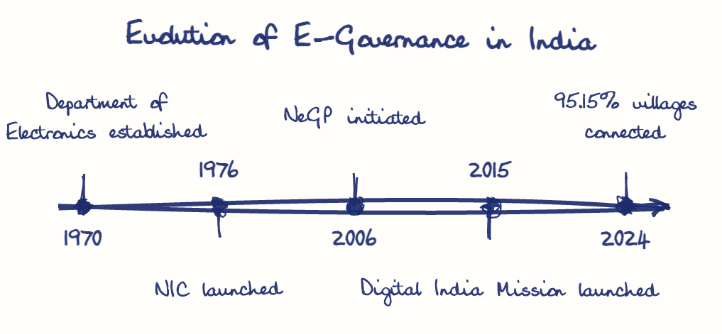
The Department of Electronics (1970) and NIC (1976) laid the groundwork for computerization; NICNET (1987) connected government1 offices nationwide; the National e-Governance Plan (NeGP) launched in 2006 aimed to enhance transparency and accessibility in service delivery.
Digital India Era
Since 2015, Digital India accelerated digital infrastructure, service delivery, and literacy, integrating schemes like DigiLocker and Mobile Seva to empower citizens digitally and bridge the urban-rural divide.
Rural Connectivity Expansion
By April 2024, 95.15% of villages have internet access, enabling rural e-governance initiatives to flourish and reduce the digital divide, fostering inclusive governance.
State and Rural Innovations
Andhra Pradesh432’s e-Seva, later succeeded by MeeSeva, offered streamlined G2C and B2C services, reducing processing times; nationally, SVAMITVA5 issued 2.63 crore property cards in 1.73 lakh villages, formalizing rural property rights; eGramSwaraj enabled 2.54 lakh Gram Panchayats6 to upload development plans, strengthening grassroots governance and transparency.
Participatory Platforms
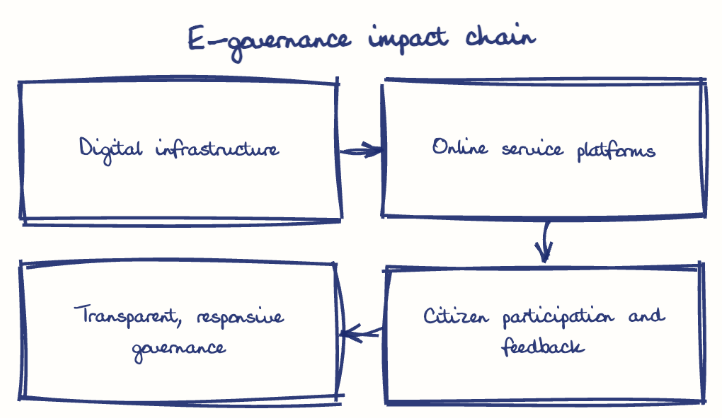
MyGov enables direct citizen-policy maker interaction, fostering participatory democracy; RailMadad provides grievance redressal and complaint tracking, enhancing government accountability.
AI and Rural Governance
SabhaSaar AI tool (2025) launched by the Ministry of Panchayati Raj summarizes Gram Panchayat meetings, improving transparency and citizen awareness in rural governance across states.
This model answer is indicative and the model can make mistakes; please verify key facts independently.
Practise this question
1Get the answer sheet
Sized for this question.
2Write your answer
Timed, by hand.
3Get it marked
Your score and what to fix.
This chapter in the exam
Information and Communication Technology (ICT)24 questions
Asked in 8 of 8 sittings since 2008
Most tested: E-governance and digital public service delivery
- 2025Define cybercrime. Discuss the major types of cybercrimes prevalent in India today.
- 2025Discuss the key objectives and features of the National Policy on Information Technology, 2012. How does it aim to transform India into a digitally empowered society?
All 24 questions, sorted by sub-topic, with model answers and practice.
Question from the official APPSC Group-I Mains 2025 paper. Answer written by Ghissu's engine and checked against our editorial standards. Found an error? Tell us and we correct it within 48 hours.