Write the salient features of Water Act and Water pollution Cess Act.
In short
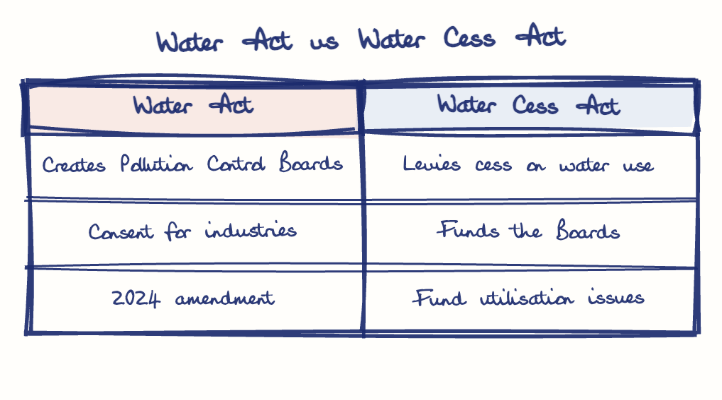
The Water Act, 1974 set up CPCB and SPCBs, required prior consent for effluent discharge and, after its 2024 amendment, fines minor offences instead of jailing offenders. The Water Cess Act, 1977 taxed industrial and municipal water use, rebating effluent treatment, until its 2017 repeal under GST.
Model answer
Ghissu Editorial · Verified 4 Oct 2026 · 269 words
Enforcement and Compliance Issues
SPCBs often lack capacity, resulting in low prosecution rates; a 2022 audit of Andhra Pradesh’s urban local bodies highlighted waste infrastructure deficits whose leachate affects water quality, showing the need for better coordination and resources.
Monitoring and Financial Utilization
The CPCB’s National Water Quality Monitoring Programme3 shows some compliance improvement among Grossly Polluting Industries4, but significant gaps remain. Cess funds once financed the Boards; after the 2017 repeal, consent fees and grants need more transparent and efficient utilization to maximize impact.
Expand Amendment Adoption and Data Use
Advocate for all states, including Andhra Pradesh, to adopt the 2024 amendments to ensure uniform regulatory practices, and utilize advanced water quality monitoring and open data policies to improve transparency and evidence-based policymaking.
This model answer is indicative and the model can make mistakes; please verify key facts independently.
Practise this question
1Get the answer sheet
Sized for this question.
2Write your answer
Timed, by hand.
3Get it marked
Your score and what to fix.
This chapter in the exam
Pollution & solid waste; global issues; environmental legislation; disaster management policy; agricultural revolutions43 questions
Asked in 8 of 8 sittings since 2008
Most tested: Solid waste management and pollution-control legislation
- 2025What are the key principles of Integrated Solid Waste Management (ISWM)? Discuss the role of waste hierarchy in ISWM.
- 2025Define global warming, and differentiate it clearly from climate change. Explain the key natural and human-induced causes of global warming and briefly discuss which factors are currently dominant in driving global temperature rise.
All 43 questions, sorted by sub-topic, with model answers and practice.
Question from the official APPSC Group-I Mains 2011 paper. Answer written by Ghissu's engine and checked against our editorial standards. Found an error? Tell us and we correct it within 48 hours.