Critically examine the situations that led to integration of Hyderabad State into the Indian Union and later formation of Andhra Pradesh.
In short
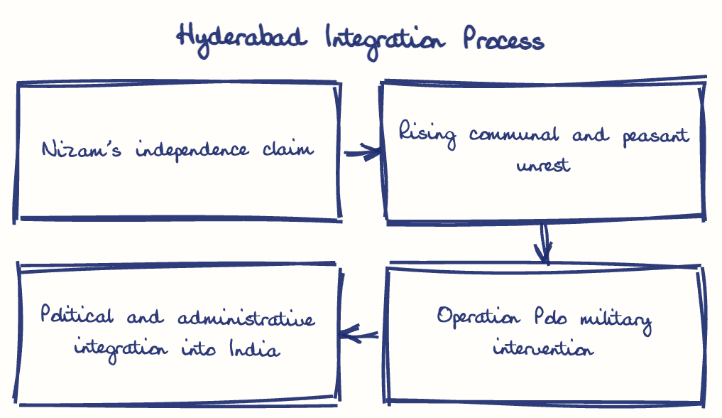
Hyderabad was integrated after the Nizam sought independence and Razakar violence and the Telangana rebellion destabilised the state, prompting Operation Polo in 1948. Andhra Pradesh followed in 1956 on linguistic grounds, but Telangana's unresolved fears under the Gentlemen's Agreement resurfaced in 1969 and led to Telangana in 2014.
Model answer
Ghissu Editorial · Verified 4 Oct 2026 · 283 words
Communal Unrest and Operation Polo
The Telangana Rebellion, a peasant uprising led by communists against feudal landlords and the Nizam’s rule, destabilized the region. The Razakars militia, supporting the Nizam’s Muslim elite, escalated communal tensions. These factors prompted India’s military intervention through Operation Polo in 1948 to restore law and order and integrate Hyderabad.
Linguistic Reorganization and SRC
The 1955 States Reorganisation Commission (SRC) examined merging the Telugu-speaking Telangana region of Hyderabad State with Andhra State, created in 1953. It saw benefits like unified control over Krishna and Godavari river basins, facilitating integrated irrigation and development projects.
Conditional Unification and Political Dynamics
The SRC recommended Telangana remain a separate state initially, with unification contingent on a two-thirds majority in the Hyderabad legislature after the 1961 elections. This delay aimed to address administrative challenges and build consensus amid persistent regional tensions.
Strengthen Regional Autonomy
Institutionalize frameworks ensuring equitable resource distribution and political representation for Telangana within Andhra Pradesh to prevent regional disparities and foster trust.
This model answer is indicative and the model can make mistakes; please verify key facts independently.
Practise this question
1Get the answer sheet
Sized for this question.
2Write your answer
Timed, by hand.
3Get it marked
Your score and what to fix.
This chapter in the exam
Andhra - Nationalist Movement and Formation of the State22 questions
Asked in 8 of 8 sittings since 2008
Most tested: Formation of Andhra Pradesh and the Andhra-Telangana statehood process
- 2025What were the provisions of the Gentlemen's Agreement of 1956? How far could they satisfy apprehensions of the Telangana region?
- 2025Outline the role of the students in raising major issues in the 1969 Telangana agitation.
All 22 questions, sorted by sub-topic, with model answers and practice.
Question from the official APPSC Group-I Mains 2012 paper. Answer written by Ghissu's engine and checked against our editorial standards. Found an error? Tell us and we correct it within 48 hours.