Describe the similarities and differences of Buddhism and Ashoka's 'Dhamma'. Discuss the impact of the both on ancient Indian Society.
In short
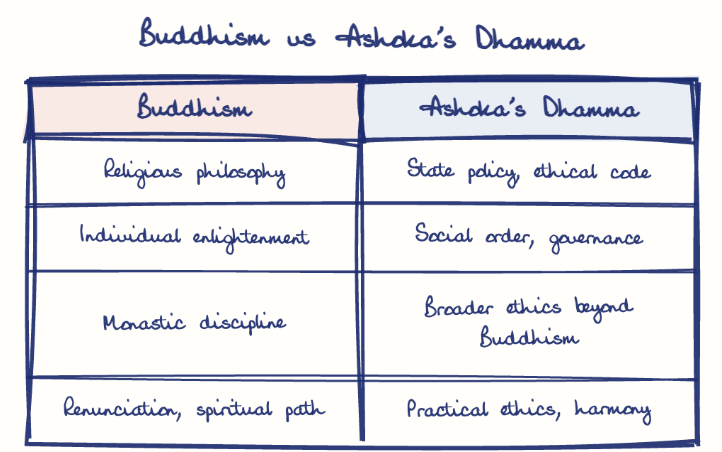
Buddhism and Ashoka's Dhamma shared non-violence, tolerance, compassion and welfare, but Buddhism was a religious path to liberation, while Dhamma was a non-sectarian code of statecraft. Together they promoted social integration, moral governance and cultural flourishing through edicts and stupas, though their lasting political effect was limited.
Model answer
Ghissu Editorial · Verified 4 Oct 2026 · 308 words
Ethical Foundations and Governance
Both emphasized virtues like non-violence and compassion; Ashoka’s ‘Dhamma’ incorporated Buddhist ethics into state policy to promote justice and reduce conflict.
Religious Tolerance and Inclusivity
Ashoka’s edicts and Buddhist doctrine advocated respect for all religions, fostering peaceful coexistence; however, Buddhism remained a religious path centered on the Four Noble Truths2, while ‘Dhamma’ was a secular, universal social ethic.
Propagation and Scope
Buddhism spread via monastic institutions and missionary work; Ashoka used inscriptions and royal patronage to disseminate ‘Dhamma’ as a public moral code beyond Buddhism’s monastic framework.
Social and Political Effects
Both challenged caste hierarchies, promoting social mobility; Ashoka’s ‘Dhamma’ helped unify the Mauryan Empire through moral governance, though its long-term political impact was limited.
Cultural Legacy
Buddhism’s emphasis on education led to institutions like Nalanda, while Ashoka’s patronage resulted in stupas and pillars enriching India’s heritage.
Limitations
Despite reforms, Ashoka’s ‘Dhamma’ did not fully prevent social conflicts or Mauryan decline; Buddhism faced internal divisions and Brahmanical resurgence.
Ethical Governance and Tolerance
Modern India can emulate Ashoka’s model by integrating ethics into administration and upholding religious freedom and respect for all faiths.
This model answer is indicative and the model can make mistakes; please verify key facts independently.
Practise this question
1Get the answer sheet
Sized for this question.
2Write your answer
Timed, by hand.
3Get it marked
Your score and what to fix.
This chapter in the exam
Ancient India - Pre-history, IVC, Vedic, Mauryas, Kushans, Satavahanas, Sangam, Guptas16 questions
Asked in 8 of 8 sittings since 2008
Most tested: Harappan civilisation—urban planning, origin/decline, and continuity.
- 2025Discuss the origin and expansion of the Indus Valley Civilization.
- 2025Briefly analyze the teachings of Buddha and Mahavira.
All 16 questions, sorted by sub-topic, with model answers and practice.
Question from the official APPSC Group-I Mains 2012 paper. Answer written by Ghissu's engine and checked against our editorial standards. Found an error? Tell us and we correct it within 48 hours.