Discuss about the role of the Andhras during different phases of National Movement.
In short
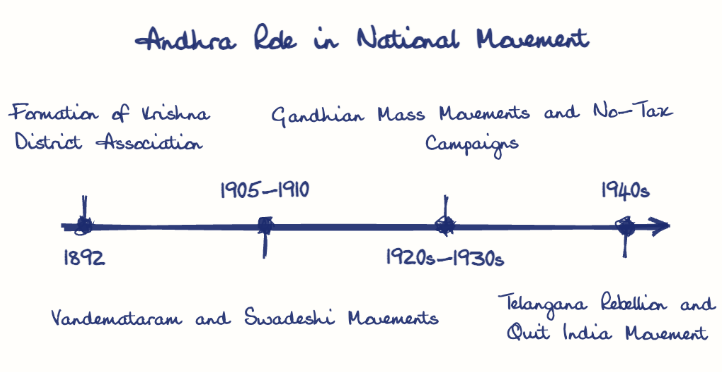
Andhras shaped every phase of the National Movement, from the Krishna District Association (1892) and Swadeshi protests to Gandhian struggles like the Chirala-Perala and Pedanandipadu no-tax campaigns. Their struggle joined national freedom with the demand for a separate state, won after Potti Sriramulu's fast on 1 October 1953.
Model answer
Ghissu Editorial · Verified 4 Oct 2026 · 287 words
Early Nationalist Engagement
The Krishna District Association (1892) was among India’s earliest political bodies; leaders like P. Rangaiah Naidu laid foundations for Andhra’s national participation. The region’s early political awakening also involved active participation in Indian National Congress sessions, establishing Andhra’s presence in the national discourse.
Gandhian Mass Movements
Andhra actively engaged in Non-Cooperation and Civil Disobedience Movements, with No-Tax Campaigns in Chirala-Perala and Forest Satyagraha in Palnadu led by Pattabhi Sitaramayya and Duggirala Gopalakrishnayya; Andhra Mahasabha articulated regional-national demands. Additionally, the mobilization of peasants and urban middle classes during these campaigns demonstrated Andhra’s broad-based involvement in Gandhian activism.
Political Agitation for Statehood
The Quit India phase saw intensified efforts for Andhra statehood, which after independence culminated in the fasts of Swami Sitaram (1951) and Potti Sriramulu (1952). The demand for a separate Andhra state gained political urgency, intertwining regional linguistic pride with the national movement.
This model answer is indicative and the model can make mistakes; please verify key facts independently.
Practise this question
1Get the answer sheet
Sized for this question.
2Write your answer
Timed, by hand.
3Get it marked
Your score and what to fix.
This chapter in the exam
Andhra - Nationalist Movement and Formation of the State22 questions
Asked in 8 of 8 sittings since 2008
Most tested: Formation of Andhra Pradesh and the Andhra-Telangana statehood process
- 2025What were the provisions of the Gentlemen's Agreement of 1956? How far could they satisfy apprehensions of the Telangana region?
- 2025Outline the role of the students in raising major issues in the 1969 Telangana agitation.
All 22 questions, sorted by sub-topic, with model answers and practice.
Question from the official APPSC Group-I Mains 2012 paper. Answer written by Ghissu's engine and checked against our editorial standards. Found an error? Tell us and we correct it within 48 hours.