Evaluate the development of Telugu Language and Literature between 1000 A.D. and 1565 A.D. with special reference to women poets.
In short
Between 1000 and 1565 AD Telugu matured from the Kavitraya's Mahabharata to the Prabandha age under Sri Krishna Deva Raya, whose Amukta Malyada and Allasani Peddana marked its zenith. Women poets like Tallapaka Timmakka (Subhadra Kalyanam) and Atukuri Molla (Molla Ramayanam) contributed meaningfully but remained few, constrained by patriarchal norms.
Model answer
Ghissu Editorial · Verified 4 Oct 2026 · 276 words
Vijayanagara Patronage and Prabandha Genre
Sri Krishna Deva Raya’s reign saw the rise of the Prabandha genre, with Allasani Peddana, the ‘Grandfather of Andhra Poetry,’ and the Ashtadiggajas enriching Telugu literature. The king’s own work, Amukta Malyada, exemplifies this golden age.
Cultural Integration and Language Evolution
Telugu literature assimilated Sanskritic and regional elements, including Shaivite texts, reflecting the socio-religious milieu and expanding the language’s expressive capacity.
Women Poets’ Presence
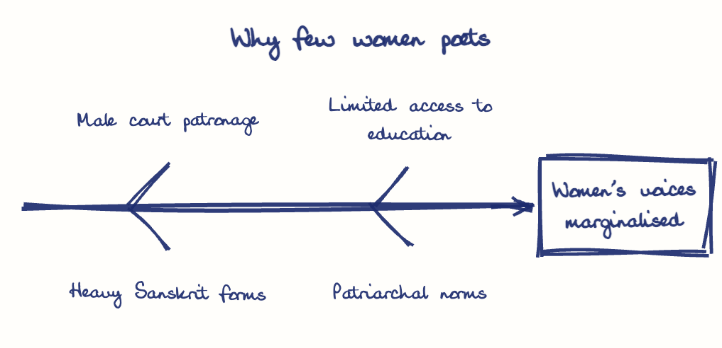
Tallapaka Timmakka’s Subhadra Kalyanam and Atukuri Molla’s Ramayanam exemplify women’s participation, highlighting devotional themes and early feminist voices within a predominantly male literary tradition.
Social Norms and Literary Marginalization
Prevailing gender roles confined women’s literary engagement mostly to devotional or domestic themes, marginalizing their perspectives in mainstream literature.
Archival Recovery and Research
Systematic preservation of women’s works in Andhra Pradesh is essential, involving academic institutions and cultural bodies to recover lost manuscripts and promote study.
Digitalization and Public Access
Digitizing manuscripts and making them accessible online will democratize Telugu literary heritage, fostering wider engagement with women’s poetry.
This model answer is indicative and the model can make mistakes; please verify key facts independently.
Sources
Practise this question
1Get the answer sheet
Sized for this question.
2Write your answer
Timed, by hand.
3Get it marked
Your score and what to fix.
This chapter in the exam
Andhra - Medieval16 questions
Asked in 8 of 8 sittings since 2008
Most tested: Telugu language and literature under medieval dynasties, especially Kakatiya, Qutub Shahi, Reddi, and Vijayanagara patronage.
- 2025Discuss the growth of various Saivite sects during the Kakatiya rule.
- 2025Discuss the significance of the Warangal Fort complex as a historical monument.
All 16 questions, sorted by sub-topic, with model answers and practice.
Question from the official APPSC Group-I Mains 2012 paper. Answer written by Ghissu's engine and checked against our editorial standards. Found an error? Tell us and we correct it within 48 hours.