Examine the factors behind the rise of Shivaji. Do you feel that he was a nationalist leader? support.
In short
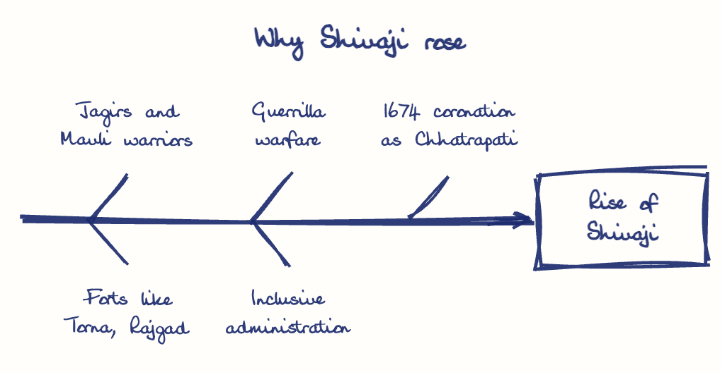
Shivaji rose through his inherited jagirs and loyal Mavlis, a network of forts like Torna and Rajgad, guerrilla warfare, inclusive administration and his 1674 coronation as Chhatrapati. He was not a nationalist in the modern sense but a proto-nationalist builder of Swarajya whose resistance inspired later nationalism.
Model answer
Ghissu Editorial · Verified 4 Oct 2026 · 299 words
Inclusive Administration
Employing Muslims and other communities in his army and administration showed pragmatic governance beyond sectarian lines, reflecting a catholic approach to statecraft that strengthened his rule.
Fortress Network and Military Innovation
Forts such as Torna and Rajgad were key defensive and symbolic assets consolidating his Swarajya, enabling him to resist Mughal advances and assert sovereignty.
Religious and Cultural Revivalism
Inspired by his mother Jijabai and guru Ramdas, Shivaji promoted Hindu symbols and festivals, fostering cultural pride and resistance that later leaders like Bal Gangadhar Tilak revived during the nationalist movement.
Contested Nationalist Symbol
The 19th and 20th-century Hindu revivalist movements shaped Shivaji’s nationalist image, sometimes projecting communal identities onto his legacy, complicating his historically inclusive governance.
Promote Inclusive Narratives
Scholarship and public discourse should present Shivaji’s legacy in a pluralistic and historically nuanced manner to foster unity rather than division.
Integrate Regional Histories
Balanced accounts of Shivaji’s role within the broader history of Indian state formation should be incorporated into national curricula to highlight regional contributions to national identity.
This model answer is indicative and the model can make mistakes; please verify key facts independently.
Practise this question
1Get the answer sheet
Sized for this question.
2Write your answer
Timed, by hand.
3Get it marked
Your score and what to fix.
This chapter in the exam
The Mughals, the Marathas & the Advent of Europeans10 questions
Asked in 7 of 8 sittings since 2008
Most tested: Shivaji and the Maratha state formation, especially rise, administration and state character.
- 2025Discuss the establishment of the East India Company and its early operations in India.
- 2025What impact did the activities of Christian missionaries have on Indian society and culture?
All 10 questions, sorted by sub-topic, with model answers and practice.
Question from the official APPSC Group-I Mains 2012 paper. Answer written by Ghissu's engine and checked against our editorial standards. Found an error? Tell us and we correct it within 48 hours.