Analyse the concept and importance of Directive Principles of State Policy. Explain the relationship and difference between the Fundamental Rights and the Directive Principles.
In short
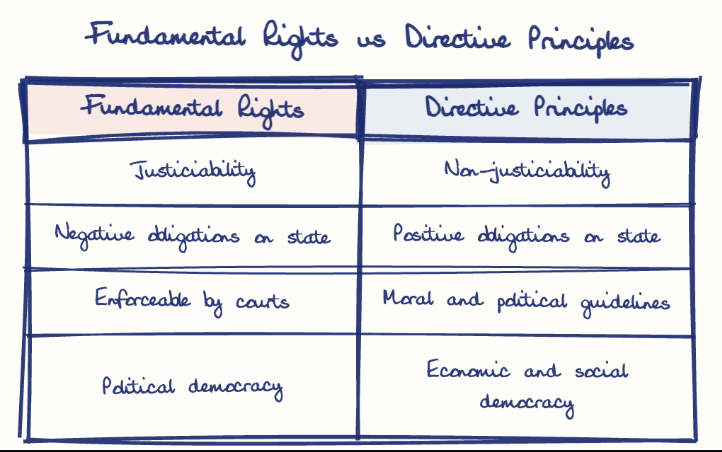
Directive Principles (Articles 36-51) are non-justiciable but fundamental guidelines directing the State towards social and economic justice and a welfare state, complementing justiciable Fundamental Rights, which restrain the State. In Minerva Mills (1980), the Supreme Court held that the balance between the two is part of the basic structure.
Model answer
Ghissu Editorial · Verified 4 Oct 2026 · 335 words
Positive State Obligations
Unlike Fundamental Rights, DPSPs require affirmative state action for equitable resource distribution, securing adequate livelihood, and protecting weaker sections, thus promoting social justice and inclusive growth.
Policy Guidance
Andhra Pradesh’s welfare schemes like Mission Indradhanush and Housing for All illustrate DPSPs’ influence on governance and social reforms, demonstrating their role in shaping progressive state policies.
Interconnected Provisions
Fundamental Rights (Part III) protect freedoms; DPSPs (Part IV) guide welfare policies, forming an organic constitutional unit as per Kesavananda Bharati case, which recognized their complementary roles in sustaining democracy.
Implementation Mechanism
Fundamental Rights are enforceable by courts through writs; DPSPs require legislative and political action, seen in Andhra Pradesh’s progressive policies that translate Directive Principles into tangible welfare measures.
Judicial and Legislative Interaction
Courts have evolved from prioritizing Fundamental Rights (Champakam Dorairajan case) to promoting a balance, encouraging legislative efforts to realize DPSPs without undermining individual freedoms.
This model answer is indicative and the model can make mistakes; please verify key facts independently.
Practise this question
1Get the answer sheet
Sized for this question.
2Write your answer
Timed, by hand.
3Get it marked
Your score and what to fix.
This chapter in the exam
Indian Constitution, Fundamental Rights, DPSP and Union-State functions18 questions
Asked in 8 of 8 sittings since 2008
Most tested: Rights, social justice, and constitutional safeguards for disadvantaged groups.
- 2025The Indian Constitution favours a federal type of government. Considering this, what duties does the Constitution place on State Governments to ensure the smooth functioning of the nation?
- 2025The Constitution of India grants certain rights to citizens and also provides measures to safeguard them. What are the key constitutional arrangements to ensure the protection of these rights?
All 18 questions, sorted by sub-topic, with model answers and practice.
Question from the official APPSC Group-I Mains 2012 paper. Answer written by Ghissu's engine and checked against our editorial standards. Found an error? Tell us and we correct it within 48 hours.