Analyse the Constitutional Amendments made so far in relation to the Fundamental Rights guaranteed under Part III of the Constitution.
In short
Amendments have both restricted and expanded Fundamental Rights: the 1st added reasonable restrictions, the 44th removed the right to property, and the 86th created the right to education under Article 21A. The Kesavananda Bharati basic structure doctrine ensures Parliament can amend but not destroy Part III.
Model answer
Ghissu Editorial · Verified 4 Oct 2026 · 284 words
Expansion of Rights
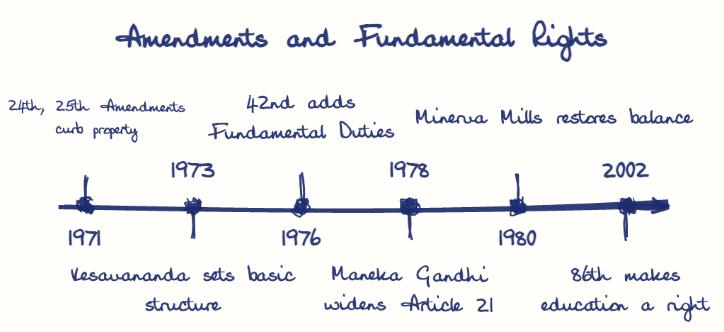
The 86th Amendment (2002) elevated free education to a Fundamental Right (Article 21A), reflecting rights’ evolution; the 42nd Amendment1 introduced Fundamental Duties, indirectly affecting rights enforcement by promoting citizen responsibility alongside rights.
Restrictive Amendments for Social Justice
The 24th and 25th Amendments (1971) empowered Parliament to amend rights to implement Directive Principles, curtailing property rights (Article 31) to promote equity. These amendments enabled affirmative action and land reforms, balancing individual rights with social welfare.
Basic Structure Doctrine2 as a Check
Kesavananda Bharati (1973) established that Parliament’s power to amend is limited by the Basic Structure Doctrine, protecting Fundamental Rights from being destroyed or damaged, thus preserving the Constitution’s core identity.
Balancing Directive Principles and Rights
The 25th Amendment allowed laws implementing Directive Principles to override some rights, but Minerva Mills (1980) reaffirmed the need to maintain balance by striking down provisions that excessively subordinated Fundamental Rights to Directive Principles.
Judicial Expansion of Rights
Maneka Gandhi (1978) broadened Article 21’s right to life to include dignity and fair procedure, complementing amendments by deepening rights’ substance and ensuring their meaningful enforcement.
This model answer is indicative and the model can make mistakes; please verify key facts independently.
Practise this question
1Get the answer sheet
Sized for this question.
2Write your answer
Timed, by hand.
3Get it marked
Your score and what to fix.
This chapter in the exam
Judiciary in India15 questions
Asked in 8 of 8 sittings since 2008
Most tested: Judicial review and its scope/limits
- 2025What are the emergency functions of the Union Government of India? Describe how they impact the legislative powers of Parliament and State Legislatures.
- 2025Discuss any two constitutional amendments that have significantly affected the powers or functioning of the Indian judiciary.
All 15 questions, sorted by sub-topic, with model answers and practice.
Question from the official APPSC Group-I Mains 2012 paper. Answer written by Ghissu's engine and checked against our editorial standards. Found an error? Tell us and we correct it within 48 hours.