Discuss the grounds on which administrative action may be reviewed by the judiciary, and the various modes of such judicial review.
In short
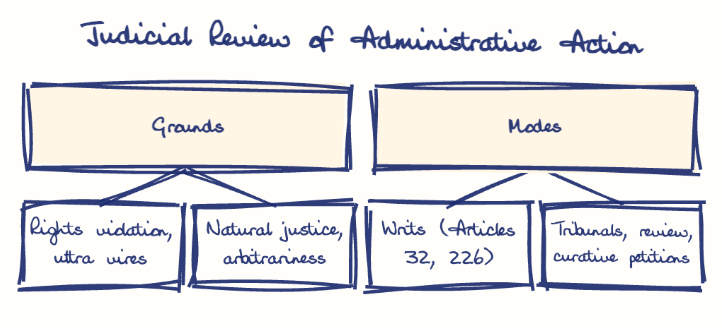
Courts review administrative action for violation of fundamental rights, excess or lack of jurisdiction, breach of natural justice, and arbitrariness under Article 14, as held in the Royappa case. They do so through writs under Articles 32 and 226, statutory appeals and tribunals, and review and curative petitions.
Model answer
Ghissu Editorial · Verified 4 Oct 2026 · 254 words
Violation of Fundamental Rights
Administrative actions violating Part III rights, such as equality (Article 14) or life and liberty (Article 21), invite review; the Sabarimala case tested constitutional morality against religious autonomy.
Excess or Lack of Jurisdiction
Courts ensure authorities act within delegated powers, as in State of W.B. v. Shivananda Pathak.
Violation of Natural Justice
Procedural fairness is mandatory; failure leads to quashing of decisions.
Arbitrariness and Unreasonableness
Article 14 prohibits arbitrary actions, per E.P. Royappa judgment.
Writ Jurisdiction
Supreme Court and High Courts use writs like certiorari, mandamus, and habeas corpus to check administrative excesses.
Constitutional Provisions
Articles 32 and 226 empower courts to hear petitions against administrative actions violating fundamental rights, with High Courts playing a key role in Andhra Pradesh.
Statutory Tribunals
The Administrative Tribunals Act, 1985, offers specialized forums for administrative disputes, significant in Andhra Pradesh.
Review and Curative Petitions
The Supreme Court can review its judgments under Article 137, ensuring justice, as in Rupa Ashok Hurra v. Ashok Hurra.
This model answer is indicative and the model can make mistakes; please verify key facts independently.
Sources
Practise this question
1Get the answer sheet
Sized for this question.
2Write your answer
Timed, by hand.
3Get it marked
Your score and what to fix.
This chapter in the exam
Judiciary in India15 questions
Asked in 8 of 8 sittings since 2008
Most tested: Judicial review and its scope/limits
- 2025What are the emergency functions of the Union Government of India? Describe how they impact the legislative powers of Parliament and State Legislatures.
- 2025Discuss any two constitutional amendments that have significantly affected the powers or functioning of the Indian judiciary.
All 15 questions, sorted by sub-topic, with model answers and practice.
Question from the official APPSC Group-I Mains 2012 paper. Answer written by Ghissu's engine and checked against our editorial standards. Found an error? Tell us and we correct it within 48 hours.