Explain the Right to Equality guaranteed under the Constitution of India in the light of the doctrine of reasonable classification.
In short
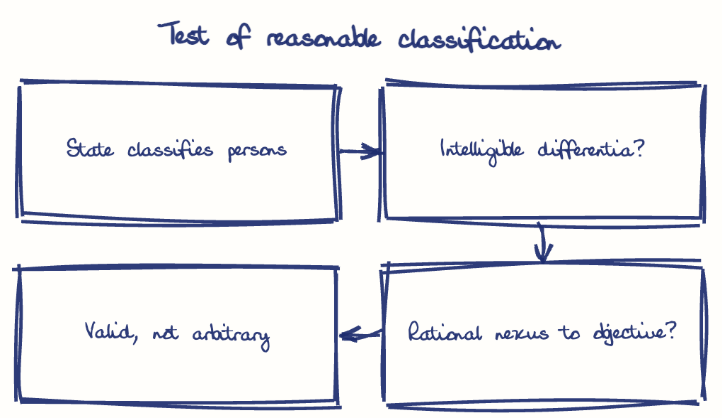
Article 14 guarantees equality before the law and equal protection of the laws, and the doctrine of reasonable classification lets the State treat unequals differently only where an intelligible differentia has a rational nexus to the law's objective. This reconciles equality with affirmative action under Articles 15(4) and 16(4).
Model answer
Ghissu Editorial · Verified 4 Oct 2026 · 302 words
Constitutional Guarantee
Article 14 guarantees equality before the law and equal protection, foundational to the rule of law.
Affirmative Action Provisions
Articles 15(4) and 16(4) permit reservations for socially and educationally backward classes, SCs, and STs to promote substantive equality.
Judicial Interpretation
The Supreme Court’s allowance of sub-classification within SC/ST reservations, as applied in Andhra Pradesh, addresses backwardness and regional disparities.
Judicial Safeguards
Courts strike down classifications that lack an intelligible differentia or a rational nexus, reflecting judicial oversight in balancing equality and affirmative action.
Definition and Tests
The doctrine permits classification based on intelligible differentia and rational nexus, preventing arbitrary discrimination.
Application in Reservations
The M. Nagaraj (2006) triple test requires quantifiable data to justify reservations, balancing equality and efficiency.
State Implementation
Andhra Pradesh uses reasonable classification to target backward communities in Rayalaseema and tribal areas.
Judicial Role
Courts scrutinize classifications to prevent misuse, ensuring laws serve legitimate social justice aims.
Balancing Equality and Diversity
Reasonable classification reconciles uniformity with the need to treat unequals differently under Article 14.
Preventing Arbitrariness
It enforces Article 14’s prohibition of arbitrariness by requiring objective criteria.
This model answer is indicative and the model can make mistakes; please verify key facts independently.
Practise this question
1Get the answer sheet
Sized for this question.
2Write your answer
Timed, by hand.
3Get it marked
Your score and what to fix.
This chapter in the exam
Indian Constitution, Fundamental Rights, DPSP and Union-State functions18 questions
Asked in 8 of 8 sittings since 2008
Most tested: Rights, social justice, and constitutional safeguards for disadvantaged groups.
- 2025The Indian Constitution favours a federal type of government. Considering this, what duties does the Constitution place on State Governments to ensure the smooth functioning of the nation?
- 2025The Constitution of India grants certain rights to citizens and also provides measures to safeguard them. What are the key constitutional arrangements to ensure the protection of these rights?
All 18 questions, sorted by sub-topic, with model answers and practice.
Question from the official APPSC Group-I Mains 2012 paper. Answer written by Ghissu's engine and checked against our editorial standards. Found an error? Tell us and we correct it within 48 hours.