Write a critical note on the Emergency Powers under the Constitution and their misuses, if any.
In short
The Constitution's emergency powers (Articles 352, 356 and 360) protect national unity but have been misused, notably the 1975 Emergency and frequent dismissals of opposition state governments under Article 356. The 44th Amendment and the Bommai judgment (1994) added safeguards against such misuse.
Model answer
Ghissu Editorial · Verified 4 Oct 2026 · 274 words
Types of Emergencies
National Emergency (Article 352), State Emergency (Article 356), and Financial Emergency (Article 360) allow suspension of rights and centralisation of power.
Safeguards and Oversight
The 44th Amendment mandates presidential action on Cabinet advice and parliamentary approval within a month to curb arbitrary use; President's Rule in undivided Andhra Pradesh in 2014 shows Article 356 in use during a transitional crisis.
Suspension of Rights and Federal Impact
During National Emergency, fundamental rights under Article 19 can be suspended and states come under Centre’s control, temporarily altering India’s federal structure.
1975 Emergency Abuse
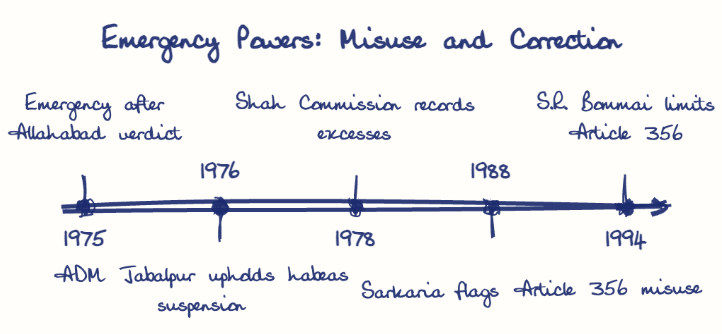
Declared by Indira Gandhi after the Allahabad High Court verdict, it suppressed dissent and civil liberties, as detailed by the Shah Commission (1978).
Article 356 Misapplication
Sarkaria Commission (1988) documented frequent misuse to dismiss opposition governments, weakening federalism; the 1984 dismissal of N.T. Rama Rao's government in Andhra Pradesh highlights this issue.
Judicial Responses
ADM Jabalpur (1976) controversially upheld suspension of habeas corpus, but S.R. Bommai (1994) imposed strict limits on Article 356, reinforcing judicial checks.
Strengthen Safeguards
Amendments should tighten emergency grounds and enhance parliamentary and judicial scrutiny.
Promote Federal Dialogue
Empowering the Inter-State Council can ease Centre-State tensions.
Judicial Vigilance and Public Awareness
Fast-track judicial review and civic education can uphold constitutional morality and prevent misuse.
This model answer is indicative and the model can make mistakes; please verify key facts independently.
Practise this question
1Get the answer sheet
Sized for this question.
2Write your answer
Timed, by hand.
3Get it marked
Your score and what to fix.
This chapter in the exam
Judiciary in India15 questions
Asked in 8 of 8 sittings since 2008
Most tested: Judicial review and its scope/limits
- 2025What are the emergency functions of the Union Government of India? Describe how they impact the legislative powers of Parliament and State Legislatures.
- 2025Discuss any two constitutional amendments that have significantly affected the powers or functioning of the Indian judiciary.
All 15 questions, sorted by sub-topic, with model answers and practice.
Question from the official APPSC Group-I Mains 2012 paper. Answer written by Ghissu's engine and checked against our editorial standards. Found an error? Tell us and we correct it within 48 hours.