Comment on the recent controversies relating to the estimates of rural-urban poverty in India.
In short
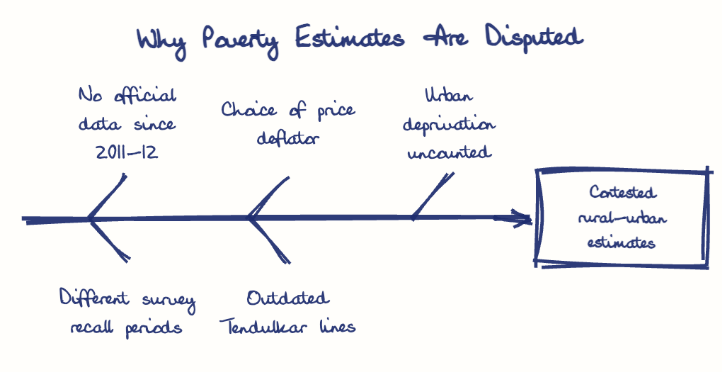
Rural-urban poverty estimates in India are disputed over inconsistent surveys and recall periods, price deflators and poverty lines seen as too low, with urban poverty likely understated. The 2011 affidavit implying about Rs 32 a day in urban and Rs 26 in rural areas triggered the sharpest controversy.
Model answer
Ghissu Editorial · Verified 4 Oct 2026 · 274 words
Poverty Line Issues
Tendulkar Committee lines, implying about Rs 32 a day in urban and Rs 26 in rural areas in 2011, were attacked as too low, especially for urban areas with distinct cost structures. Critics argue these lines fail to capture multidimensional deprivation, leading to underestimation of urban poverty.
Policy Targeting Risks
Inaccurate estimates may misdirect schemes like MGNREGS and PDS, vital for rural Andhra Pradesh, leaving urban poor underserved. This risks excluding vulnerable groups in urban slums and drought-prone rural areas like Rayalaseema.
Public Trust Erosion
Divergent data fuels scepticism about poverty reduction claims, complicating consensus on development priorities. Political debates intensify as official figures often report urban poverty below 5%, while studies suggest rates up to 40-60%.
State-Level Variations
Andhra Pradesh’s uneven rural poverty despite 2024-25 GSDP growth highlights masked local disparities. This underscores the need for state-specific poverty assessments beyond aggregate figures.
Update Poverty Lines
New expert committees should revise poverty lines reflecting current consumption and multidimensional poverty. Incorporating indices like the National Multidimensional Poverty Index3 can better capture urban and rural deprivation.
This model answer is indicative and the model can make mistakes; please verify key facts independently.
Practise this question
1Get the answer sheet
Sized for this question.
2Write your answer
Timed, by hand.
3Get it marked
Your score and what to fix.
This chapter in the exam
Inclusive Growth: India and AP schemes49 questions
Asked in 8 of 8 sittings since 2008
Most tested: Women empowerment and poverty reduction through AP welfare and credit-linked institutions
- 2025Elaborate on the meaning of Inclusive Growth in the context of the Indian economy. Discuss the key strategies and instruments that can be employed to foster greater inclusion and ensure that the benefits of economic growth reach all sections of society.
- 2025Critically Examine the major poverty alleviation and employment generation programmes in India. How effective have they been in addressing rural and urban poverty?
All 49 questions, sorted by sub-topic, with model answers and practice.
Question from the official APPSC Group-I Mains 2012 paper. Answer written by Ghissu's engine and checked against our editorial standards. Found an error? Tell us and we correct it within 48 hours.