Declining share of agriculture in national income facilitated a rise in the rate of economic growth in India. - Justify your answer
In short
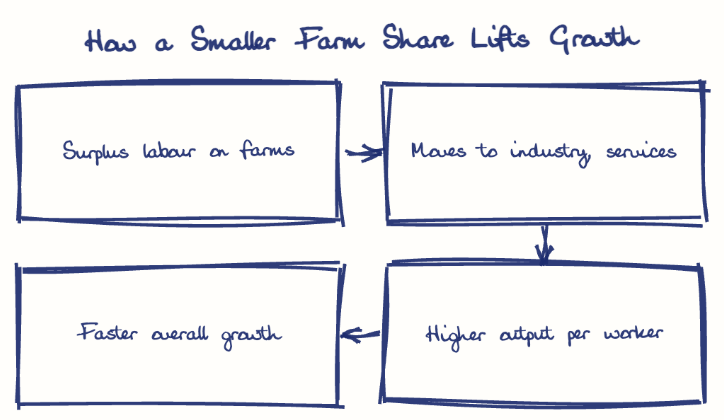
The declining share of agriculture in national income has raised India's growth rate by shifting labour and capital from low-productivity farming to higher-productivity industry and services. Agriculture's share fell from about 18.2% in 2014-15 to 16.5% in 2019-20, though it still employs over 45% of the workforce.
Model answer
Ghissu Editorial · Verified 4 Oct 2026 · 251 words
Structural Transformation Dynamics
Agriculture4’s share dropped from 18.2% (2014-15) to 16.5% (2019-20), reflecting faster industrial and service sector growth that boosts overall productivity. This shift aligns with the classical Lewis model of economic development, where surplus labour moves from low-productivity agriculture to higher-productivity sectors.
Policy and Institutional Support
Government schemes such as Pradhan Mantri Fasal Bima Yojana, Pradhan Mantri Krishi Sinchayee Yojana, and Soil Health Card Scheme5 have enhanced productivity and stabilized incomes in Andhra Pradesh. Additionally, the state’s active participation in e-NAM has improved market access for farmers, complementing agro-based industrialisation efforts.
Fiscal and Growth Linkages
Andhra Pradesh’s projected GSDP growth of 9.24% in 2024-25, outpacing national average, reflects benefits of structural shifts and strong fiscal management. Increased tax revenues and infrastructure investments further support rural economies and non-agricultural sectors.
Promote Agro-Industrialisation
Developing agro-processing clusters in Andhra Pradesh can diversify rural incomes and create non-farm employment, reducing dependence on traditional crop agriculture and enhancing value addition.
This model answer is indicative and the model can make mistakes; please verify key facts independently.
Practise this question
1Get the answer sheet
Sized for this question.
2Write your answer
Timed, by hand.
3Get it marked
Your score and what to fix.
This chapter in the exam
Agricultural Development (India)16 questions
Asked in 7 of 8 sittings since 2008
Most tested: Agricultural credit and market regulation/price policy.
- 2025Examine the significance of agriculture finance, production, and marketing in the context of India's agricultural development. Discuss the challenges and opportunities associated with financing agricultural activities, improving production, and developing efficient marketing systems to support sustainable growth in the agricultural sector.
- 2025Explain the role of the Agricultural Produce Market Committee (APMC) Act in Agricultural Price Policy in regulating the agricultural market in India. What are the issues that have been observed by policy makers regarding the functioning of the APMC Act?
All 16 questions, sorted by sub-topic, with model answers and practice.
Question from the official APPSC Group-I Mains 2012 paper. Answer written by Ghissu's engine and checked against our editorial standards. Found an error? Tell us and we correct it within 48 hours.