Describe the changing structure of land holdings in Andhra Pradesh in the past two decades
In short
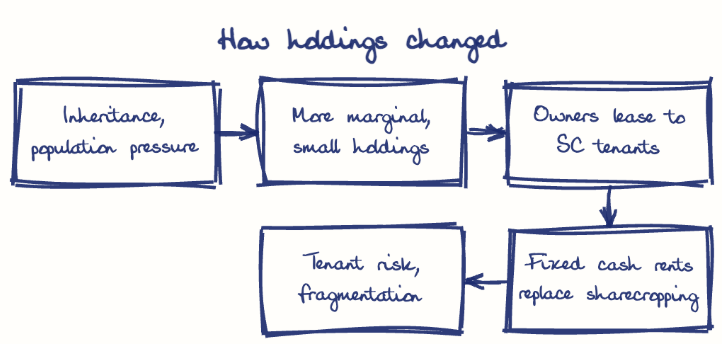
Over the past two decades, landholdings in Andhra Pradesh have become smaller and more fragmented, increasingly leased rather than owned, and more often on fixed cash rent. About 34.8% of operated area was under tenancy by 2012-13, and fixed rent tenancy rose from 29.9% to 55% between 2002 and 2012.
Model answer
Ghissu Editorial · Verified 4 Oct 2026 · 241 words
Growth of Marginal and Small Holdings
Fragmentation from inheritance and population growth has increased marginal and small holdings, notably in the Godavari-Krishna delta, aligning with national trends.
Expansion of Tenancy Cultivation
The share of leased-in land by tenants, especially Scheduled Castes, has risen sharply, exceeding all-India averages and reflecting a shift towards tenancy-based farming.
Legal Reforms and Assigned Lands
Amendments in tenancy laws (1956, 2011, 2019) and the 2023 Assigned Lands Act have regulated leases and enabled transfer of assigned lands; over 20.24 lakh farmers gained freehold titles covering 35.45 lakh acres, empowering Dalits but also sparking controversies.
Socio-Economic and Caste Dynamics
Forward castes moving to non-farm sectors lease lands to marginalized groups, reshaping agrarian relations and reflecting caste-based inequalities.
Land Security and Vulnerability
Title deeds have improved tenure security and credit access, while rising fixed rent tenancy increases tenant farmers’ economic risks, limiting investment capacity.
Fragmentation Challenges
Predominance of small holdings hinders mechanization and scale economies, requiring cooperative or FPO models for productivity gains.
This model answer is indicative and the model can make mistakes; please verify key facts independently.
Practise this question
1Get the answer sheet
Sized for this question.
2Write your answer
Timed, by hand.
3Get it marked
Your score and what to fix.
This chapter in the exam
Agriculture Development in Andhra Pradesh31 questions
Asked in 8 of 8 sittings since 2008
Most tested: Agriculture’s structure, performance, and state policy interventions in Andhra Pradesh.
- 2025Discuss the role of agriculture in the economic development of Andhra Pradesh. How has agriculture contributed to the State Gross Domestic Product (SGDP) in recent years? Identify the key drivers influencing its performance.
- 2025What are the key drivers for the growth of the fisheries sector? What are the schemes undertaken by the fisheries department for the growth of this sector?
All 31 questions, sorted by sub-topic, with model answers and practice.
Question from the official APPSC Group-I Mains 2012 paper. Answer written by Ghissu's engine and checked against our editorial standards. Found an error? Tell us and we correct it within 48 hours.