Discuss the problems associated with the issue of land distribution in Andhra Pradesh State.
In short
Land distribution in Andhra Pradesh suffers from caste-based inequities, dilution of assigned land protections, corrupt and weak land administration, and displacement without adequate rehabilitation. The 2023 amendment to the Assigned Lands (Prohibition of Transfers) Act eased transfers of Dalit assigned lands, prompting allegations of insider acquisition.
Model answer
Ghissu Editorial · Verified 4 Oct 2026 · 267 words
Historical Caste Inequities
Despite land reforms distributing 50 lakh acres, upper-caste dominance persists, marginalizing Dalits and Adivasis.
Legal Amendments Undermining Assigned Lands
The 2023 amendment to the Andhra Pradesh Assigned Lands (Prohibition of Transfers) Act relaxed protections, enabling corruption and insider trading against Dalit assignees.
Corruption and Revenue Loss
Andhra Pradesh CAG Audit (2021-22) reported ₹1,806 crore2 revenue loss in tax and land departments, reflecting systemic inefficiencies.
Displacement and Rehabilitation
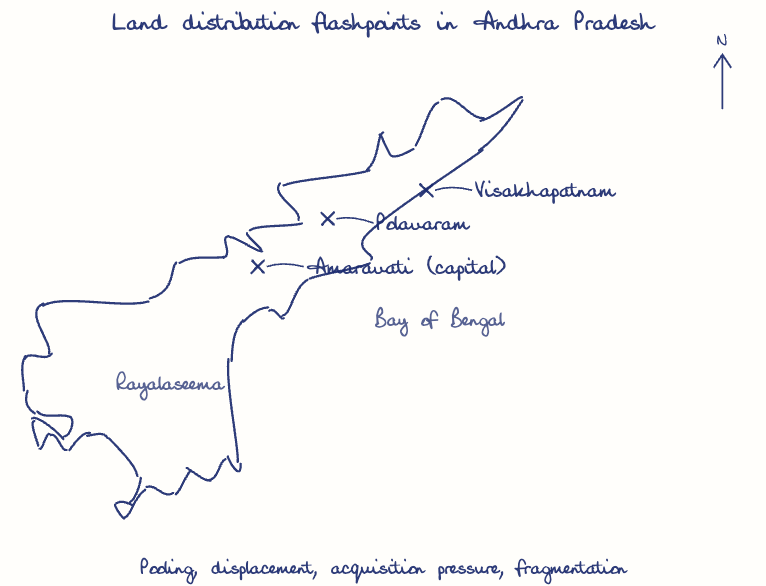
The Polavaram Project displaced over one lakh families, but only 11% of Project Displaced Families have been rehabilitated, indicating poor resettlement.
State Reorganisation and Capital Development
Post-2014 bifurcation, Amaravati land pooling faced insider trading allegations, exposing governance gaps.
Social Welfare and Assigned Lands
Attempts to convert assigned lands to freehold without National Commission for Scheduled Castes’ consultation raise constitutional concerns.
Regional Disparities
Coastal districts like Visakhapatnam face industrial land pressures, while Rayalaseema struggles with fragmented holdings and low productivity.
Economic Consequences
Land insecurity fuels distress sales and migration, undermining goals like Swarna Andhra Vision 20473.
Legal Safeguards
Reinstate strict transfer prohibitions on assigned lands with constitutional compliance.
Transparency
Use digital land records and grievance redressal to curb corruption, inspired by Andhra Pradesh’s e-Seva platform.
Equitable Land Use
Formulate region-specific policies addressing coastal and drought-prone areas.
This model answer is indicative and the model can make mistakes; please verify key facts independently.
Practise this question
1Get the answer sheet
Sized for this question.
2Write your answer
Timed, by hand.
3Get it marked
Your score and what to fix.
This chapter in the exam
Agriculture Development in Andhra Pradesh31 questions
Asked in 8 of 8 sittings since 2008
Most tested: Agriculture’s structure, performance, and state policy interventions in Andhra Pradesh.
- 2025Discuss the role of agriculture in the economic development of Andhra Pradesh. How has agriculture contributed to the State Gross Domestic Product (SGDP) in recent years? Identify the key drivers influencing its performance.
- 2025What are the key drivers for the growth of the fisheries sector? What are the schemes undertaken by the fisheries department for the growth of this sector?
All 31 questions, sorted by sub-topic, with model answers and practice.
Question from the official APPSC Group-I Mains 2012 paper. Answer written by Ghissu's engine and checked against our editorial standards. Found an error? Tell us and we correct it within 48 hours.