Elucidate the problems of cooperatives in providing adequate agricultural credit to farmers in Andhra Pradesh.
In short
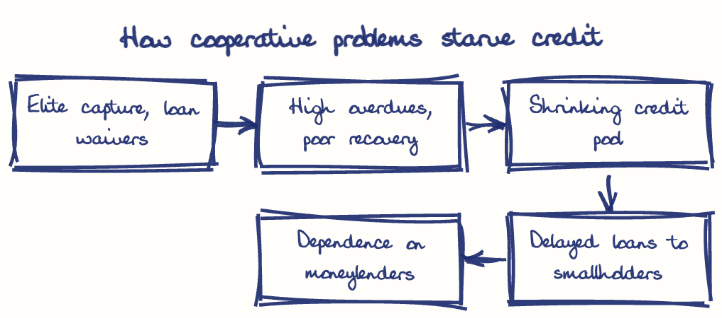
Cooperatives in Andhra Pradesh struggle to provide adequate farm credit because large landowners dominate them, overdues and loan waivers erode their funds, land-collateral rules exclude tenants and labourers, and management is weak. As a result, small farmers receive insufficient, delayed credit and turn to high-interest moneylenders.
Model answer
Ghissu Editorial · Verified 4 Oct 2026 · 264 words
Large Landowner Control
Cooperative leadership dominated by wealthy farmers diverts credit from smallholders, perpetuating inequality in Andhra Pradesh. This concentration often results in credit being used for non-agricultural purposes, reducing funds available for genuine farming needs.
Loan Defaults and Political Interference
High overdues and loan waivers undermine cooperatives’ financial viability and credit availability. Political interference often leads to delayed recoveries, weakening the cooperative credit system’s sustainability.
Dependence on Informal Credit
Insufficient cooperative credit forces farmers to rely on moneylenders charging exorbitant rates, increasing vulnerability and indebtedness among small and marginal farmers.
Regional Disparities and Credit Inequality
Uneven distribution of cooperative credit in Andhra Pradesh aggravates agrarian distress and economic disparities across regions and social groups.
Inclusive Credit Schemes
Expanding Kisan Credit Card coverage and collateral-free loans in Andhra Pradesh will enhance credit access for marginalized farmers, including tenant farmers and landless laborers.
Integration with State Initiatives
Linking cooperatives with Andhra Pradesh’s Rythu Seva Kendras, e-Seva, and other platforms offers one-stop farmer services, combining credit with extension and market access.
This model answer is indicative and the model can make mistakes; please verify key facts independently.
Practise this question
1Get the answer sheet
Sized for this question.
2Write your answer
Timed, by hand.
3Get it marked
Your score and what to fix.
This chapter in the exam
Agriculture Development in Andhra Pradesh31 questions
Asked in 8 of 8 sittings since 2008
Most tested: Agriculture’s structure, performance, and state policy interventions in Andhra Pradesh.
- 2025Discuss the role of agriculture in the economic development of Andhra Pradesh. How has agriculture contributed to the State Gross Domestic Product (SGDP) in recent years? Identify the key drivers influencing its performance.
- 2025What are the key drivers for the growth of the fisheries sector? What are the schemes undertaken by the fisheries department for the growth of this sector?
All 31 questions, sorted by sub-topic, with model answers and practice.
Question from the official APPSC Group-I Mains 2012 paper. Answer written by Ghissu's engine and checked against our editorial standards. Found an error? Tell us and we correct it within 48 hours.