Examine the view that Public Distribution System in India shall be made the responsibility of State Governments.
In short
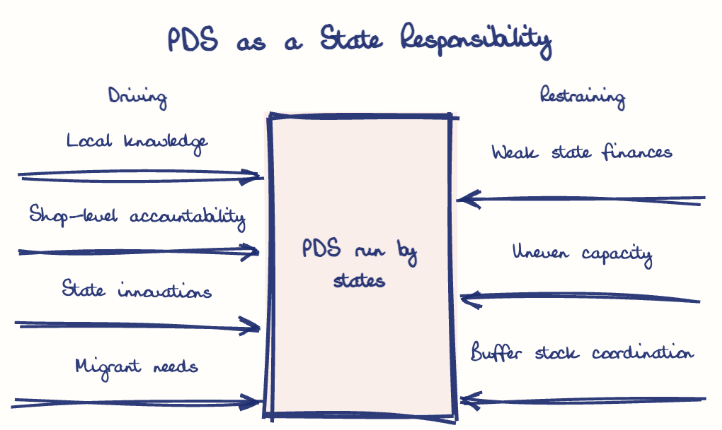
Making the Public Distribution System a state responsibility has merit for distribution, where states know local needs and can cut leakages, but procurement, storage and buffer stocks need national scale and central finance. A cooperative model is wiser, given about 61% exclusion and 25% inclusion errors nationally.
Model answer
Ghissu Editorial · Verified 4 Oct 2026 · 262 words
Centre-State Dual Roles
The Centre procures food grains via FCI and allocates them; states identify beneficiaries and manage distribution, with states like Andhra Pradesh adopting digitisation and monitoring reforms.
Procurement and Storage Issues
Audits reveal storage shortfalls and wastage, questioning centralised procurement sustainability.
Local Needs and Flexibility
States can customise PDS to local conditions, as Andhra Pradesh uses technology for ration card portability and grievance redressal under One Nation-One Ration Card.
Accountability and Efficiency
State control can reduce bureaucratic delays3 and improve transparency, supported by State Level Standing Committees (SLSC) and District Development Coordination and Monitoring Committees (DISHA).
Fiscal Constraints
Andhra Pradesh’s fiscal deficit target (3.8%4 of GSDP) shows the limited fiscal room states have to carry large food subsidies, a key risk in decentralisation.
Monitoring and Innovation
Audits revealing ₹968 Cr excess payments in Andhra Pradesh stress the need for robust oversight, while state IT-enabled monitoring shows the scope for innovation.
Strengthen State Capacity
Invest in infrastructure and technology, learning from Andhra Pradesh’s digitisation and monitoring efforts.
Enhance Fiscal Transfers
Increase earmarked grants for food security.
Robust Monitoring
Empower committees like SLSC and DISHA for transparency.
This model answer is indicative and the model can make mistakes; please verify key facts independently.
Practise this question
1Get the answer sheet
Sized for this question.
2Write your answer
Timed, by hand.
3Get it marked
Your score and what to fix.
This chapter in the exam
Inclusive Growth: India and AP schemes49 questions
Asked in 8 of 8 sittings since 2008
Most tested: Women empowerment and poverty reduction through AP welfare and credit-linked institutions
- 2025Elaborate on the meaning of Inclusive Growth in the context of the Indian economy. Discuss the key strategies and instruments that can be employed to foster greater inclusion and ensure that the benefits of economic growth reach all sections of society.
- 2025Critically Examine the major poverty alleviation and employment generation programmes in India. How effective have they been in addressing rural and urban poverty?
All 49 questions, sorted by sub-topic, with model answers and practice.
Question from the official APPSC Group-I Mains 2012 paper. Answer written by Ghissu's engine and checked against our editorial standards. Found an error? Tell us and we correct it within 48 hours.