Write a brief note on the regional disparities in irrigation facilities in Andhra Pradesh.
In short
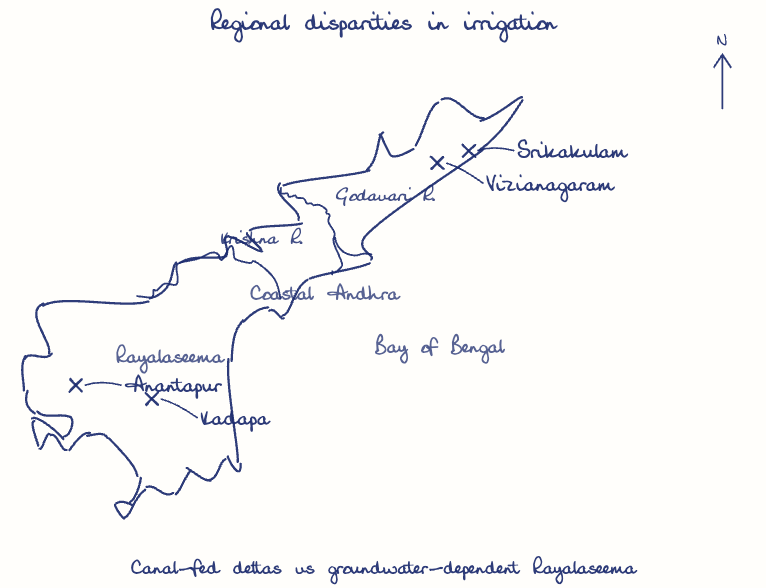
Irrigation in Andhra Pradesh is sharply uneven: canal-fed Godavari and Krishna delta districts are well served, while drought-prone Rayalaseema and northern districts depend on scarce groundwater and lag behind. About 95% of minor irrigation relies on groundwater, and delays at Polavaram and Veligonda have limited efforts to close the gap.
Model answer
Ghissu Editorial · Verified 4 Oct 2026 · 252 words
Polavaram Project5 Issues
The Polavaram Project faces delays with only 67.43% land acquired and 11% of Project Displaced Families rehabilitated, limiting its potential to reduce disparities. Its slow progress hampers irrigation expansion in water-scarce regions.
Fragmented Management
Multiple agencies managing irrigation cause coordination problems, affecting equitable water distribution. The Water Resources Department and local bodies often lack synergy, leading to inefficient resource allocation and maintenance challenges.
Micro-Irrigation and Groundwater
Micro-irrigation adoption is high in Anantapuramu but low in others; 95% of minor irrigation depends on groundwater, unevenly available and overexploited in drought-prone areas. Groundwater depletion risks threaten long-term sustainability, especially where tube wells dominate irrigation.
Integrated Management and Project Completion
Strengthen coordination among agencies and expedite Polavaram’s land acquisition and rehabilitation to unlock irrigation potential. Integrated Water Resource Management can ensure equitable water distribution across regions.
Expand Micro-Irrigation and Sustainable Use
Increase subsidies and training for micro-irrigation and enforce groundwater regulation, especially in drought-prone districts. Promoting rainwater harvesting and recharge structures can improve groundwater sustainability.
This model answer is indicative and the model can make mistakes; please verify key facts independently.
Practise this question
1Get the answer sheet
Sized for this question.
2Write your answer
Timed, by hand.
3Get it marked
Your score and what to fix.
This chapter in the exam
Agriculture Development in Andhra Pradesh31 questions
Asked in 8 of 8 sittings since 2008
Most tested: Agriculture’s structure, performance, and state policy interventions in Andhra Pradesh.
- 2025Discuss the role of agriculture in the economic development of Andhra Pradesh. How has agriculture contributed to the State Gross Domestic Product (SGDP) in recent years? Identify the key drivers influencing its performance.
- 2025What are the key drivers for the growth of the fisheries sector? What are the schemes undertaken by the fisheries department for the growth of this sector?
All 31 questions, sorted by sub-topic, with model answers and practice.
Question from the official APPSC Group-I Mains 2012 paper. Answer written by Ghissu's engine and checked against our editorial standards. Found an error? Tell us and we correct it within 48 hours.