Define bioinsecticides, What are the different types of bioinsecticides?
In short
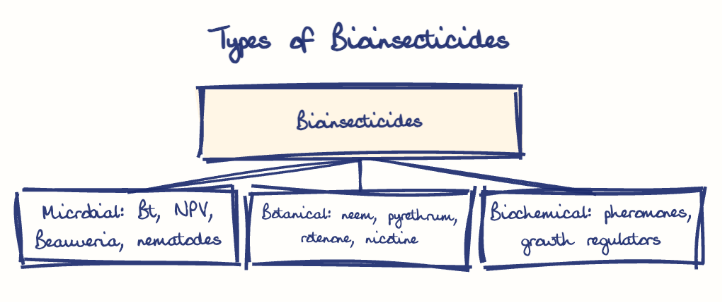
Bioinsecticides are pest-control agents derived from living organisms or natural products that kill or repel insects with high specificity and low toxicity. They are microbial (Bacillus thuringiensis, nuclear polyhedrosis virus, Beauveria bassiana, nematodes), botanical (neem azadirachtin, pyrethrum, rotenone, nicotine) and biochemical (pheromones and insect growth regulators).
Model answer
Ghissu Editorial · Verified 4 Oct 2026 · 299 words
Regulatory Oversight
The Insecticides Act, 1968, with the Central Insecticide Board and Registration Committee, regulates bioinsecticides like Bt and neem extracts, ensuring safety and efficacy. This framework mandates rigorous evaluation before market approval, safeguarding environmental and consumer health.
Policy and Funding
The BioE3 Policy (2024) and Bio-RIDE scheme (Rs 1,500 crore) promote biotechnology innovation and commercialization, reducing import dependence and fostering indigenous bioinsecticide development. These initiatives also encourage public-private partnerships and capacity building in biotechnology sectors.
Botanical and Biochemical Bioinsecticides
Neem azadirachtin, pyrethrum, and pheromones offer biodegradable, less toxic pest control options, supporting integrated pest management and Mission LiFE’s sustainability goals. Insect growth regulators disrupt pest life cycles, enhancing control efficacy without ecological harm.
Research Contributions
Acharya N.G. Ranga Agricultural University and Sri Venkateswara University enhance local bioinsecticide research, adapting solutions to regional pest challenges. Their work supports development of microbial and botanical agents suited to Andhra Pradesh’s diverse agro-climatic zones.
This model answer is indicative and the model can make mistakes; please verify key facts independently.
Practise this question
1Get the answer sheet
Sized for this question.
2Write your answer
Timed, by hand.
3Get it marked
Your score and what to fix.
This chapter in the exam
Human diseases; genetic engineering basics; biotechnology in agriculture; vaccines54 questions
Asked in 8 of 8 sittings since 2008
Most tested: Vaccines and immunisation, alongside GM crops/biotech agriculture.
- 2025Discuss the transmission dynamics of respiratory tract infections in densely populated urban settings. Propose effective public health strategies for their prevention.
- 2025Examine how urban infrastructure influences the implementation of preventive measures during microbial disease outbreaks. Suggest technology-driven solutions.
All 54 questions, sorted by sub-topic, with model answers and practice.
Question from the official APPSC Group-I Mains 2012 paper. Answer written by Ghissu's engine and checked against our editorial standards. Found an error? Tell us and we correct it within 48 hours.