Explain briefly on the role and responsibilities of National Disaster Management Authority (NDMA) in achieving its goal.
In short
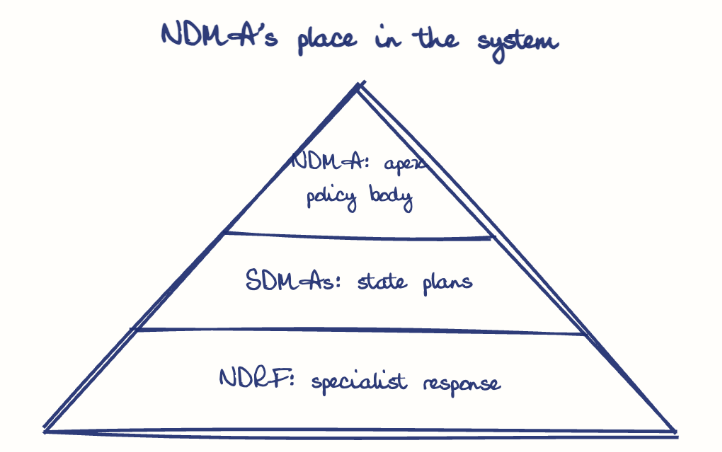
The NDMA, created under the Disaster Management Act, 2005 and chaired by the Prime Minister, is India's apex body that lays down disaster policy, approves the National Plan, guides SDMAs and ministries and controls the NDRF. Its goal of a disaster-resilient India depends on these roles reaching districts and communities.
Model answer
Ghissu Editorial · Verified 4 Oct 2026 · 264 words
Apex Policy Formulator
NDMA formulates and approves comprehensive national disaster management policies and the National Plan, providing strategic guidance to central ministries and departments to ensure a unified disaster preparedness framework.
Resource Mobilization and Oversight
NDMA recommends funds for disaster mitigation and frames guidelines that shape the use of response funds such as the state-administered State Disaster Response Fund (SDRF), and exercises superintendence over the National Disaster Response Force (NDRF), which now comprises 16 battalions equipped for specialist disaster response.
Holistic and Inclusive Disaster Management
By integrating disaster risk reduction into developmental planning and promoting community awareness, NDMA reduces vulnerabilities and fosters resilience. It also sets minimum standards for relief and rehabilitation, ensuring a humane and equitable approach to disaster response.
State-Level Empowerment
Through coordination and capacity building with SDMAs like Andhra Pradesh, NDMA enables localized, context-specific disaster management strategies, improving effectiveness on the ground and ensuring that regional challenges are addressed appropriately.
This model answer is indicative and the model can make mistakes; please verify key facts independently.
Practise this question
1Get the answer sheet
Sized for this question.
2Write your answer
Timed, by hand.
3Get it marked
Your score and what to fix.
This chapter in the exam
Pollution & solid waste; global issues; environmental legislation; disaster management policy; agricultural revolutions43 questions
Asked in 8 of 8 sittings since 2008
Most tested: Solid waste management and pollution-control legislation
- 2025What are the key principles of Integrated Solid Waste Management (ISWM)? Discuss the role of waste hierarchy in ISWM.
- 2025Define global warming, and differentiate it clearly from climate change. Explain the key natural and human-induced causes of global warming and briefly discuss which factors are currently dominant in driving global temperature rise.
All 43 questions, sorted by sub-topic, with model answers and practice.
Question from the official APPSC Group-I Mains 2012 paper. Answer written by Ghissu's engine and checked against our editorial standards. Found an error? Tell us and we correct it within 48 hours.