In the Project Tiger, what are the administrative measures taken by the Ministry of Environment and Forests.
In short
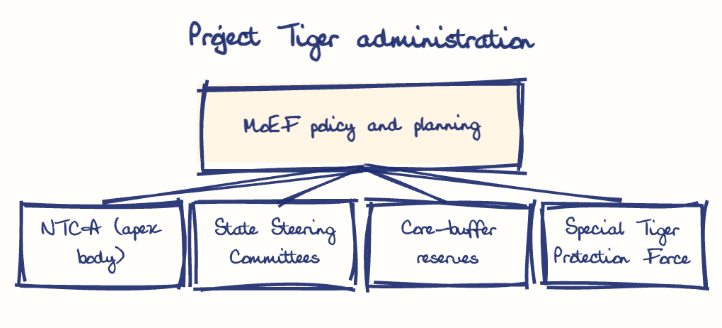
Under Project Tiger, launched in 1973, the Ministry adopted a core-buffer strategy for tiger reserves, created the Special Tiger Protection Force, funded states through centrally sponsored schemes and set up the NTCA to issue conflict-management SOPs. These measures helped India host around 70% of the world's tigers.
Model answer
Ghissu Editorial · Verified 4 Oct 2026 · 278 words
Core-Buffer Zoning and Reserves
The Ministry enforces a core-buffer strategy in tiger reserves like Nagarjunsagar-Srisailam in Andhra Pradesh4, ensuring strict protection of core areas and regulated human activity in buffer zones to reduce habitat fragmentation.
Special Tiger Protection Force (STPF)
Established under Project Tiger, the STPF combats poaching with patrolling, intelligence, and enforcement, supported by infrastructure funded by the Ministry.
Financial and Technical Support
The Ministry allocates funds through Centrally Sponsored Schemes for habitat management, anti-poaching, and community relocation, with notable 2022-23 funding for infrastructure and water maintenance.
Policy and Coordination
The Ministry formulates policies like the National Wildlife Action Plan, oversees the NTCA, and coordinates with states via Steering Committees chaired by Chief Ministers.
Monitoring and Scientific Collaboration
It monitors tiger populations and reserve effectiveness using data from institutions like the Wildlife Institute of India and conducts spatial assessments.
Capacity Building and International Cooperation
The Ministry promotes training, community engagement, and trans-boundary conservation agreements with Nepal, Bangladesh, and China.
Community Participation and Technology
Enhance local involvement and use GIS, camera traps, and AI for monitoring.
Funding and Legal Frameworks
Increase financial support, especially in Andhra Pradesh, and refine policies to harmonize forest rights with conservation.
This model answer is indicative and the model can make mistakes; please verify key facts independently.
Practise this question
1Get the answer sheet
Sized for this question.
2Write your answer
Timed, by hand.
3Get it marked
Your score and what to fix.
This chapter in the exam
Biotechnology & Nanotechnology: scope, ethics, genetic engineering, biodiversity, fermentation, immuno-diagnosis50 questions
Asked in 8 of 8 sittings since 2008
Most tested: Biodiversity and biotechnology governance/ethics, especially conservation, GMOs, and applied public-health biotech.
- 2025Trace the evolution of India's National Biotechnology Development Strategy (NBDS) and discuss its key objectives. Critically evaluate its impact on the growth of the biotechnology sector in India.
- 2025Analyze the potential of plant-derived biopharmaceuticals in promoting sustainable healthcare. Explain how the application of green pharmacy principles can help minimize environmental harm at each stage of the pharmaceutical lifecycle.
All 50 questions, sorted by sub-topic, with model answers and practice.
Question from the official APPSC Group-I Mains 2012 paper. Answer written by Ghissu's engine and checked against our editorial standards. Found an error? Tell us and we correct it within 48 hours.