What are the parameters considered to declare as a disaster? List out the various disasters which considered for declaration as national disasters.
In short
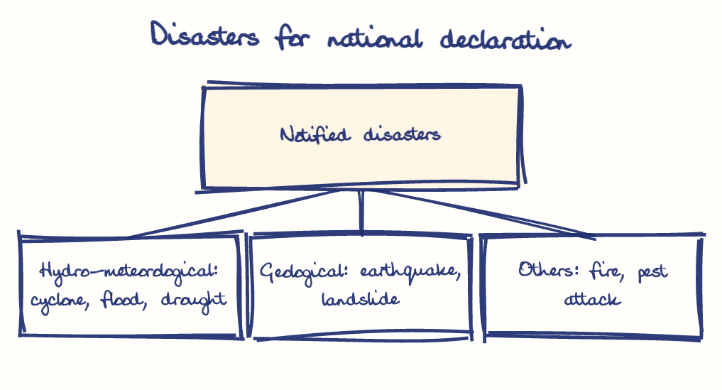
A disaster is declared when the scale of damage, loss of life, disruption and economic burden exceed the affected community's capacity to cope. India has no legal category of national disaster, but the Centre notifies twelve disasters, including cyclone, flood, drought, earthquake and tsunami, eligible for SDRF and NDRF assistance.
Model answer
Ghissu Editorial · Verified 4 Oct 2026 · 265 words
Casualty and Economic Loss
Includes human casualties, injuries, and significant economic damage, notably to crops, livestock, and livelihoods, which affect recovery potential.
Hazard Type and Frequency
Natural or human-made hazards and their recurrence patterns are considered to assess risk and potential impact severity.
Geographical Extent and Population Affected
The size of the affected area and the number of people impacted are critical in determining the disaster’s scale and need for national intervention.
Natural Disasters
Cyclones, floods, droughts (notably in Rayalaseema), earthquakes, landslides, tsunamis (posing risk to Andhra Pradesh coast), avalanches, and cloudbursts are recognized due to their frequent and severe impacts.
Other Disasters
Fires (forest and urban), hailstorms, cold waves, pest attacks affecting agriculture, and frost or cold waves complete the twelve notified disasters; epidemics such as COVID-19 have been specially notified, and states may use part of SDRF for local disasters.
Coordination and Funding
Effective disaster declaration requires seamless coordination between central and Andhra Pradesh state agencies, including the National Disaster Response Force and State Disaster Response Force. Funding from the National Disaster Response Fund1 and State Disaster Response Fund is critical but often insufficient to cover extensive damages, as seen in recent cyclones.
This model answer is indicative and the model can make mistakes; please verify key facts independently.
Sources
Practise this question
1Get the answer sheet
Sized for this question.
2Write your answer
Timed, by hand.
3Get it marked
Your score and what to fix.
This chapter in the exam
Pollution & solid waste; global issues; environmental legislation; disaster management policy; agricultural revolutions43 questions
Asked in 8 of 8 sittings since 2008
Most tested: Solid waste management and pollution-control legislation
- 2025What are the key principles of Integrated Solid Waste Management (ISWM)? Discuss the role of waste hierarchy in ISWM.
- 2025Define global warming, and differentiate it clearly from climate change. Explain the key natural and human-induced causes of global warming and briefly discuss which factors are currently dominant in driving global temperature rise.
All 43 questions, sorted by sub-topic, with model answers and practice.
Question from the official APPSC Group-I Mains 2012 paper. Answer written by Ghissu's engine and checked against our editorial standards. Found an error? Tell us and we correct it within 48 hours.