What are the Principles of Ecology?
In short
Ecology's principles hold that the ecosystem is the basic functional unit, energy flows one way while nutrients cycle, limiting factors control growth, and carrying capacity and succession shape communities. A key example is Lindeman's ten percent law, under which only about 10% of energy passes between trophic levels.
Model answer
Ghissu Editorial · Verified 4 Oct 2026 · 276 words
Hierarchical Levels of Organization
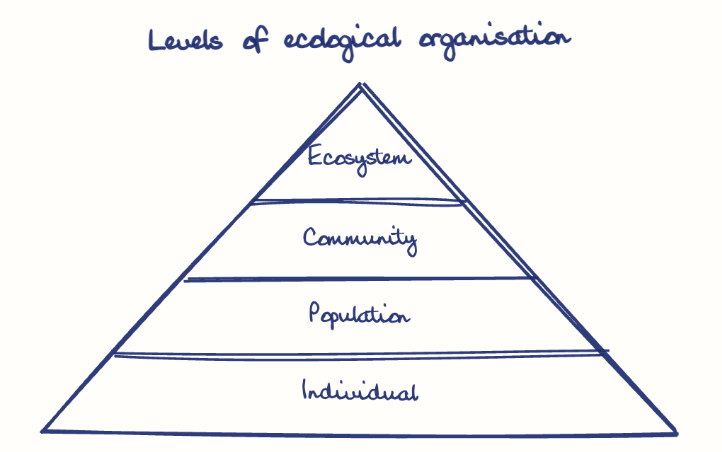
Ecology studies individuals, populations, communities, and ecosystems, each with unique interactions shaping ecological patterns.
Anthropogenic Impacts
Activities like deforestation, pollution, and aquaculture expansion in Andhra Pradesh's coastal areas disrupt ecological balance and cause biodiversity loss.
Institutional Constraints
Enforcement and coordination issues persist in agencies such as the Andhra Pradesh Pollution Control Board, limiting effective ecological governance.
Community Participation
Traditional knowledge and local involvement enhance stewardship, demonstrated by participatory forest management in Eastern Ghats tribal areas.
Adaptive Management and Restoration
Ecological principles applied in restoration, such as mangrove reforestation in Coringa and the Krishna estuary, help recover biodiversity and ecosystem services.
Education and Awareness
Ecological literacy campaigns like Ek Ped Maa Ke Naam1 foster public support for conservation efforts.
Strengthen Institutions
Enhance capacity of bodies like the Andhra Pradesh Forest Department through training and resources for effective ecological management.
Ecosystem-Based Management
Adopt holistic approaches considering entire ecosystems, especially in sensitive zones like coastal Andhra Pradesh.
Integrate Ecology in Development Planning
Mandate ecological impact assessments and incorporate ecological data in infrastructure projects, ensuring sustainability in urbanizing regions like the Amaravati capital region.
Foster Community Engagement
Empower local stakeholders via participatory governance to align conservation with socio-economic needs.
This model answer is indicative and the model can make mistakes; please verify key facts independently.
Sources
Practise this question
1Get the answer sheet
Sized for this question.
2Write your answer
Timed, by hand.
3Get it marked
Your score and what to fix.
This chapter in the exam
Biotechnology & Nanotechnology: scope, ethics, genetic engineering, biodiversity, fermentation, immuno-diagnosis50 questions
Asked in 8 of 8 sittings since 2008
Most tested: Biodiversity and biotechnology governance/ethics, especially conservation, GMOs, and applied public-health biotech.
- 2025Trace the evolution of India's National Biotechnology Development Strategy (NBDS) and discuss its key objectives. Critically evaluate its impact on the growth of the biotechnology sector in India.
- 2025Analyze the potential of plant-derived biopharmaceuticals in promoting sustainable healthcare. Explain how the application of green pharmacy principles can help minimize environmental harm at each stage of the pharmaceutical lifecycle.
All 50 questions, sorted by sub-topic, with model answers and practice.
Question from the official APPSC Group-I Mains 2012 paper. Answer written by Ghissu's engine and checked against our editorial standards. Found an error? Tell us and we correct it within 48 hours.