What are the salient benefits of the application of Information Technology in the field of medicine and medical health?
In short
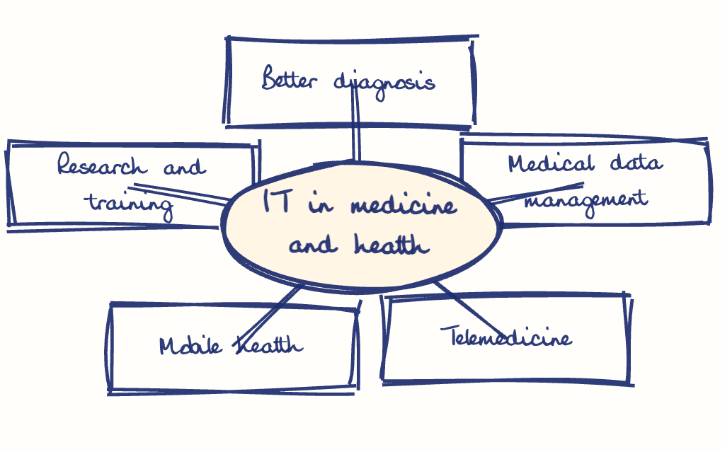
Information Technology improves medicine through faster AI-aided diagnosis, interoperable electronic health records, telemedicine for remote areas, mobile health tools for frontline workers and data-driven research and policy. The Ayushman Bharat Digital Mission and the eSanjeevani telemedicine platform show how IT is widening access and moving India towards universal health coverage.
Model answer
Ghissu Editorial · Verified 4 Oct 2026 · 271 words
Improved Diagnosis and Patient Care
AI-powered tools provide second opinions and predictive analytics, helping flag tuberculosis patients at risk of adverse outcomes and improving diabetic retinopathy detection. These technologies enhance clinical decision-making and patient safety by enabling early and accurate diagnosis.
Comprehensive Data Management
The National Digital Health Blueprint enables interoperable Electronic Health Records; ABDM has issued over 799 million digital health IDs, facilitating seamless data sharing and continuity of care. This reduces duplication of tests and supports evidence-based treatment protocols.
Telemedicine and Remote Care
eSanjeevani OPD has conducted over 183 million consultations, expanding healthcare access in rural India and reducing infection risks. It bridges the urban-rural divide by connecting patients with specialists without the need for travel.
Enhance Healthcare Provider Training
Build capacity on digital tools and data privacy in Andhra Pradesh health facilities to ensure effective adoption and safeguard patient information.
Promote Data Privacy Frameworks
Align with the National Digital Health Blueprint to secure patient data and build trust in digital health systems.
This model answer is indicative and the model can make mistakes; please verify key facts independently.
Practise this question
1Get the answer sheet
Sized for this question.
2Write your answer
Timed, by hand.
3Get it marked
Your score and what to fix.
This chapter in the exam
Pollution & solid waste; global issues; environmental legislation; disaster management policy; agricultural revolutions43 questions
Asked in 8 of 8 sittings since 2008
Most tested: Solid waste management and pollution-control legislation
- 2025What are the key principles of Integrated Solid Waste Management (ISWM)? Discuss the role of waste hierarchy in ISWM.
- 2025Define global warming, and differentiate it clearly from climate change. Explain the key natural and human-induced causes of global warming and briefly discuss which factors are currently dominant in driving global temperature rise.
All 43 questions, sorted by sub-topic, with model answers and practice.
Question from the official APPSC Group-I Mains 2012 paper. Answer written by Ghissu's engine and checked against our editorial standards. Found an error? Tell us and we correct it within 48 hours.