What is the difference between renewable energy and non-renewable energy? What are the different types of non-conventional energy? Add a note on their resources.
In short
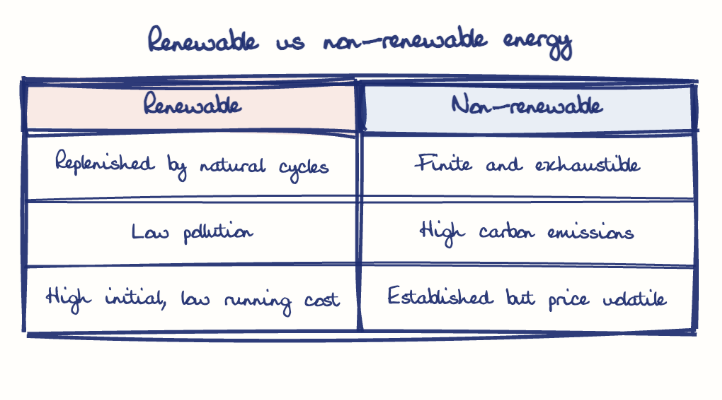
Renewable energy comes from naturally replenishing sources like sun, wind and biomass and is clean, whereas fossil-fuel energy is finite and carbon-intensive. Non-conventional types are solar, wind, biomass, small hydro (up to 25 MW), geothermal, tidal and hydrogen fuel cells, with rich solar and coastal wind resources in Andhra Pradesh.
Model answer
Ghissu Editorial · Verified 4 Oct 2026 · 318 words
Definition and Impact
Renewable energy sources like solar and wind2 replenish naturally and emit minimal pollution; non-renewables such as coal and petroleum are finite and major carbon emitters contributing to climate change.
Solar and Wind Energy
India’s solar capacity reached 140 GW by January 20263, with Andhra Pradesh’s solar parks contributing significantly due to high solar insolation; wind energy capacity is 54.65 GW, with coastal regions like Andhra Pradesh playing a key role.
Biomass and Hydropower
Biomass still fuels cooking in many rural homes, supported by Andhra Pradesh’s agrarian economy providing ample residues; hydropower utilizes rivers like Godavari and Krishna for electricity generation through small and large projects.
Emerging Energy Sources
Geothermal and tidal energy have potential but require advanced technology and investment; the National Green Hydrogen Mission aims to scale hydrogen fuel cells for clean energy, enhancing storage and transport options.
Global Alliances and National Missions
The International Solar Alliance4 (ISA), Global Bio-fuels Alliance, and Green Grids Initiative-OSOWOG (GGI-OSOWOG) promote renewable cooperation; India’s national missions like the National Solar Mission support these efforts, while the Africa Renewable Energy Initiative (AREI) exemplifies global outreach.
This model answer is indicative and the model can make mistakes; please verify key facts independently.
Practise this question
1Get the answer sheet
Sized for this question.
2Write your answer
Timed, by hand.
3Get it marked
Your score and what to fix.
This chapter in the exam
Energy: needs, resources, policy; Nuclear programme and policy24 questions
Asked in 8 of 8 sittings since 2008
Most tested: Renewable energy transition in India, especially solar/clean energy and barriers to large-scale adoption.
- 2025Differentiate between conventional and non-conventional energy resources. Explain their relevance in India's energy sector.
- 2023What is the current scenario of renewable power generation in India ? Discuss the factors responsible for the growing focus and shift towards Renewable energy.
All 24 questions, sorted by sub-topic, with model answers and practice.
Question from the official APPSC Group-I Mains 2012 paper. Answer written by Ghissu's engine and checked against our editorial standards. Found an error? Tell us and we correct it within 48 hours.