Write a short note on Eutrophication.
In short
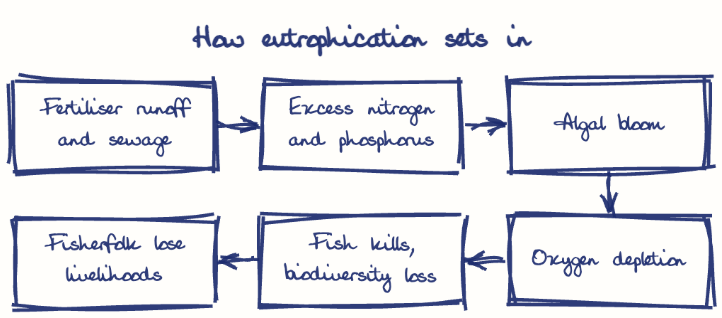
Eutrophication is the nutrient enrichment of water bodies by fertiliser runoff, sewage and industrial effluents, causing excessive algal and plant growth that depletes oxygen and kills fish. It is controlled through balanced fertiliser use under the Soil Health Card scheme, better sewage treatment under AMRUT and wetland restoration.
Model answer
Ghissu Editorial · Verified 4 Oct 2026 · 280 words
Pollution Control Boards’ Role
The Central and Andhra Pradesh Pollution Control Boards actively monitor water quality under the National Water Quality Monitoring Programme1 (NWMP), identifying eutrophic water bodies and enforcing pollution norms to reduce nutrient loads from agriculture and sewage.
River Rejuvenation Committees
The Central Monitoring Committee (CMC) and state-level River Rejuvenation Committees (RRCs) coordinate restoration efforts to reduce nutrient inflows causing eutrophication, focusing on rivers like Krishna and Godavari in Andhra Pradesh.
Agricultural Runoff
Intensive fertiliser use in crops like chilli and horticulture in Andhra Pradesh leads to nutrient leaching into rivers and reservoirs, accelerating eutrophication and harming aquatic life through oxygen depletion and fish kills.
Sewage Treatment Deficits
Many sewage treatment plants operate below capacity or are outdated, resulting in untreated effluents entering water bodies and increasing nutrient pollution, especially in urban areas of Andhra Pradesh.
Nutrient Management Policies
The Soil Health Card Scheme and promotion of neem-coated urea help reduce excess fertiliser runoff in Andhra Pradesh by encouraging balanced nutrient application and organic farming practices.
Infrastructure Upgrades
Schemes like AMRUT and the National River Conservation Plan support modernising sewage treatment infrastructure to limit nutrient discharge and restore water quality in urban and peri-urban areas.
This model answer is indicative and the model can make mistakes; please verify key facts independently.
Sources
Practise this question
1Get the answer sheet
Sized for this question.
2Write your answer
Timed, by hand.
3Get it marked
Your score and what to fix.
This chapter in the exam
Pollution & solid waste; global issues; environmental legislation; disaster management policy; agricultural revolutions43 questions
Asked in 8 of 8 sittings since 2008
Most tested: Solid waste management and pollution-control legislation
- 2025What are the key principles of Integrated Solid Waste Management (ISWM)? Discuss the role of waste hierarchy in ISWM.
- 2025Define global warming, and differentiate it clearly from climate change. Explain the key natural and human-induced causes of global warming and briefly discuss which factors are currently dominant in driving global temperature rise.
All 43 questions, sorted by sub-topic, with model answers and practice.
Question from the official APPSC Group-I Mains 2012 paper. Answer written by Ghissu's engine and checked against our editorial standards. Found an error? Tell us and we correct it within 48 hours.