Write a short note on Pathogenesis.
In short
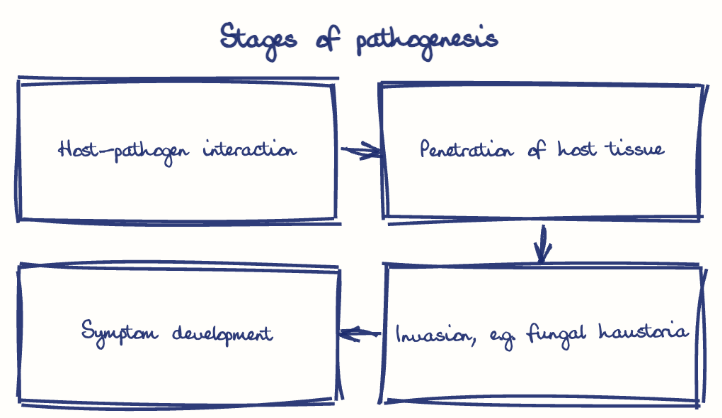
Pathogenesis is the chain of events by which a pathogen causes disease in a plant, from penetration and invasion of host tissue, often via fungal haustoria, to symptom development. Its course depends on host-pathogen interaction and environment, and understanding it, a field pioneered in India by Butler, guides disease management.
Model answer
Ghissu Editorial · Verified 4 Oct 2026 · 253 words
Pioneering Expertise
E. J. Butler’s foundational work shaped Indian plant pathology; Andhra Pradesh institutions continue research on local pathogens, focusing on disease causation and control strategies.
Pathogen Traits and Diagnosis
Identification of fungal structures like haustoria enables targeted disease control. Precise pathogen classification aids in developing specific interventions.
Complex Pathogen Behavior
Diverse infection modes like ectophytic and endophytic growth complicate managing diseases such as downy mildew and rust in Andhra Pradesh, requiring detailed understanding of pathogen-host interactions.
Environmental Impact
Climatic variability across Andhra Pradesh affects disease progression unpredictably, influencing pathogen virulence and host susceptibility.
Strengthen Research
Boost funding and infrastructure in Andhra Pradesh to study local pathogen dynamics and host-pathogen interactions for better disease management.
Promote Resistant Varieties
Breeding programs informed by pathogenesis can develop crops resistant to prevalent diseases, enhancing yield stability.
Farmer Training
Extension services should educate farmers on disease symptoms and management, integrating traditional knowledge with modern science.
Integrated Management
Combining chemical, biological, and cultural methods based on pathogenesis can sustainably reduce disease impact and improve crop health.
This model answer is indicative and the model can make mistakes; please verify key facts independently.
Practise this question
1Get the answer sheet
Sized for this question.
2Write your answer
Timed, by hand.
3Get it marked
Your score and what to fix.
This chapter in the exam
Human diseases; genetic engineering basics; biotechnology in agriculture; vaccines54 questions
Asked in 8 of 8 sittings since 2008
Most tested: Vaccines and immunisation, alongside GM crops/biotech agriculture.
- 2025Discuss the transmission dynamics of respiratory tract infections in densely populated urban settings. Propose effective public health strategies for their prevention.
- 2025Examine how urban infrastructure influences the implementation of preventive measures during microbial disease outbreaks. Suggest technology-driven solutions.
All 54 questions, sorted by sub-topic, with model answers and practice.
Question from the official APPSC Group-I Mains 2012 paper. Answer written by Ghissu's engine and checked against our editorial standards. Found an error? Tell us and we correct it within 48 hours.