Describe major contributions of Great Mughals to Indian Architecture.
In short
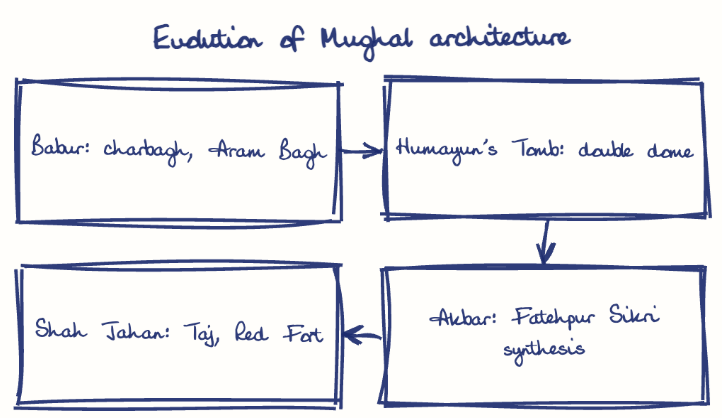
The Great Mughals created an Indo-Islamic architectural synthesis: Babur introduced charbagh gardens, Humayun's Tomb pioneered the double dome, Akbar blended Hindu and Islamic forms at Fatehpur Sikri, and Shah Jahan perfected marble grandeur. The Taj Mahal, Buland Darwaza, Red Fort and Shalimar Bagh showcase this legacy.
Model answer
Ghissu Editorial · Verified 4 Oct 2026 · 275 words
Persian Charbagh Gardens
Babur introduced charbagh gardens like Aram Bagh in Agra, featuring symmetrical quadrilateral layouts with water channels symbolizing paradise. These gardens set a precedent for later monumental garden designs such as Shalimar Bagh in Kashmir.
Double Dome and Material Fusion
Humayun’s Tomb pioneered the double dome technique and combined red sandstone with white marble, setting standards for later monuments like the Taj Mahal. This innovation allowed grander exterior domes while maintaining interior proportions.
Syncretic Style at Fatehpur Sikri
Akbar’s architecture integrated Hindu features such as chhatris with Islamic arches, reflecting syncretism and inclusivity. The use of trabeate construction alongside Islamic motifs exemplified cultural synthesis.
Monumental Forts and Gateways
Akbar’s Buland Darwaza and Shah Jahan’s Red Fort combined military utility with aesthetic grandeur, symbolizing imperial power and architectural excellence.
Ornamental Calligraphy and Jali Screens
Quranic inscriptions and intricate jali enhanced spiritual depth and ventilation, as in Jama Masjid. These elements also contributed to light diffusion and artistic detail.
Syncretic Heritage Education
Promote Mughal architecture’s composite nature in curricula to foster appreciation of India’s pluralistic cultural heritage.
This model answer is indicative and the model can make mistakes; please verify key facts independently.
Sources
Practise this question
1Get the answer sheet
Sized for this question.
2Write your answer
Timed, by hand.
3Get it marked
Your score and what to fix.
This chapter in the exam
The Mughals, the Marathas & the Advent of Europeans10 questions
Asked in 7 of 8 sittings since 2008
Most tested: Shivaji and the Maratha state formation, especially rise, administration and state character.
- 2025Discuss the establishment of the East India Company and its early operations in India.
- 2025What impact did the activities of Christian missionaries have on Indian society and culture?
All 10 questions, sorted by sub-topic, with model answers and practice.
Question from the official APPSC Group-I Mains 2016 paper. Answer written by Ghissu's engine and checked against our editorial standards. Found an error? Tell us and we correct it within 48 hours.