Describe the contribution of Andhra Mahasabha in socio cultural development.
In short
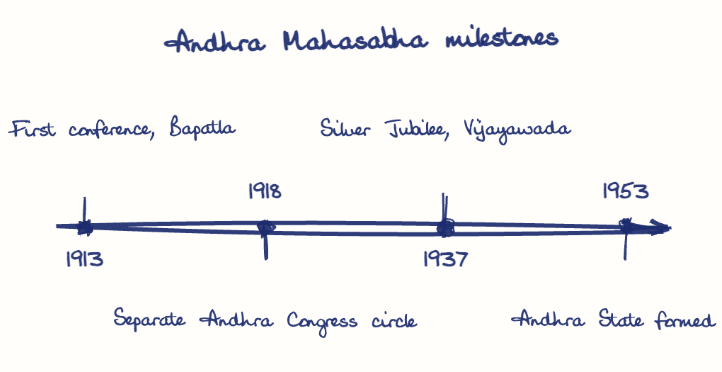
The Andhra Mahasabha, meeting annually from Bapatla in 1913, promoted Telugu language and culture, worked to unite the Circar and Rayalaseema regions and demanded fair representation for Telugu people. Its persistent demand for a separate province paved the way for Andhra State in 1953.
Model answer
Ghissu Editorial · Verified 4 Oct 2026 · 255 words
Promotion of Telugu Language and Culture
Through annual conferences starting in 1913 at Bapatla, the Mahasabha celebrated Telugu heritage and addressed socio-cultural issues. These gatherings became forums for literary discussions, cultural performances, and debates on social reforms, strengthening Telugu cultural pride.
Advocacy for Separate Andhra Province
Resolutions at the 1931 Madras conference and 1937 Vijayawada Silver Jubilee emphasized linguistic reorganization, demanding a separate Andhra province. The Mahasabha’s efforts influenced the formation of the Andhra Congress circle in 1918, which politically mobilized Telugu aspirations for administrative autonomy.
Catalyst for Provincial Reorganization
Persistent demands led to the formation of Andhra State in 1953, enabling region-specific socio-economic development. This reorganization allowed focused policies on education, language promotion, and social welfare tailored to Telugu cultural contexts.
Enhance Educational Outreach
Expand Telugu-medium education to reinforce linguistic identity alongside modern skills. Supporting institutions dedicated to Telugu arts and heritage will continue the cultural legacy.
This model answer is indicative and the model can make mistakes; please verify key facts independently.
Practise this question
1Get the answer sheet
Sized for this question.
2Write your answer
Timed, by hand.
3Get it marked
Your score and what to fix.
This chapter in the exam
Andhra - Nationalist Movement and Formation of the State22 questions
Asked in 8 of 8 sittings since 2008
Most tested: Formation of Andhra Pradesh and the Andhra-Telangana statehood process
- 2025What were the provisions of the Gentlemen's Agreement of 1956? How far could they satisfy apprehensions of the Telangana region?
- 2025Outline the role of the students in raising major issues in the 1969 Telangana agitation.
All 22 questions, sorted by sub-topic, with model answers and practice.
Question from the official APPSC Group-I Mains 2016 paper. Answer written by Ghissu's engine and checked against our editorial standards. Found an error? Tell us and we correct it within 48 hours.