Trace the reasons for success and subsequent failure of Telangana people's armed struggle.
In short
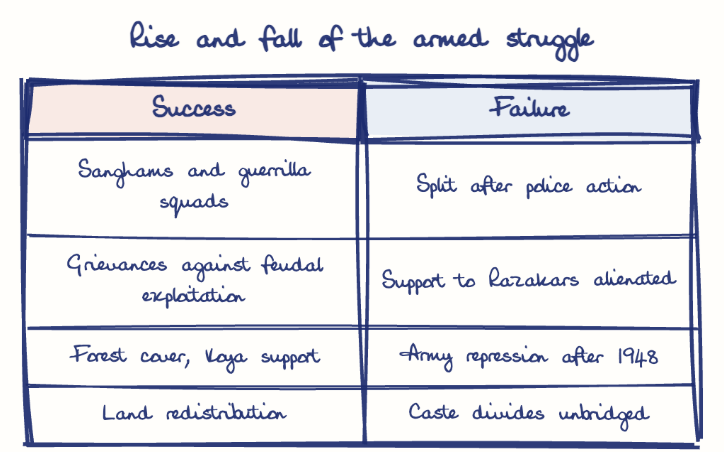
The Telangana armed struggle first succeeded through Communist-led peasant mobilisation against vetti and feudal landlords, guerrilla tactics in forested terrain and tribal support, organised in village sanghams and dalams. After the 1948 Police Action, party divisions, fighting the Indian Army, repression and caste fragmentation ended it in October 1951.
Model answer
Ghissu Editorial · Verified 4 Oct 2026 · 295 words
Effective Peasant Mobilization
Communist leaders like Ravi Narayana Reddi and P. Sundarayya organized village sanghams and guerrilla squads, creating disciplined resistance that united peasants, sharecroppers, and tribal groups.
Communist Party Divisions
Post-1948 police action, splits over armed struggle versus peaceful politics fragmented the movement, weakening its coherence and resolve.
Fighting the Indian Army
Continuing armed struggle against the Indian Army after the Nizam's surrender, amid allegations of a tactical understanding with the Nizam's regime, alienated peasants and nationalists who saw the anti-Nizam aim as achieved.
Social Fragmentation
Upper-caste resistance and caste divides limited unity among peasants, preventing a sustained united front against feudal forces.
Inclusive Agrarian Reforms
Land redistribution for Dalits and tenants to address feudal inequities and ensure socio-economic justice in rural Telangana.
Tribal Cultural Empowerment
Support for tribal languages and folk arts to preserve heritage and empower marginalized communities.
Grassroots Political Participation
Decentralize governance to empower rural voices and prevent elite capture of development processes.
Gender Inclusion
Recognize women’s leadership, inspired by Telangana’s historic female role in the armed struggle, to strengthen social movements.
This model answer is indicative and the model can make mistakes; please verify key facts independently.
Practise this question
1Get the answer sheet
Sized for this question.
2Write your answer
Timed, by hand.
3Get it marked
Your score and what to fix.
This chapter in the exam
Andhra - Nationalist Movement and Formation of the State22 questions
Asked in 8 of 8 sittings since 2008
Most tested: Formation of Andhra Pradesh and the Andhra-Telangana statehood process
- 2025What were the provisions of the Gentlemen's Agreement of 1956? How far could they satisfy apprehensions of the Telangana region?
- 2025Outline the role of the students in raising major issues in the 1969 Telangana agitation.
All 22 questions, sorted by sub-topic, with model answers and practice.
Question from the official APPSC Group-I Mains 2016 paper. Answer written by Ghissu's engine and checked against our editorial standards. Found an error? Tell us and we correct it within 48 hours.