What are the important features of major schools of art that flourished during post Mauryan period?
In short
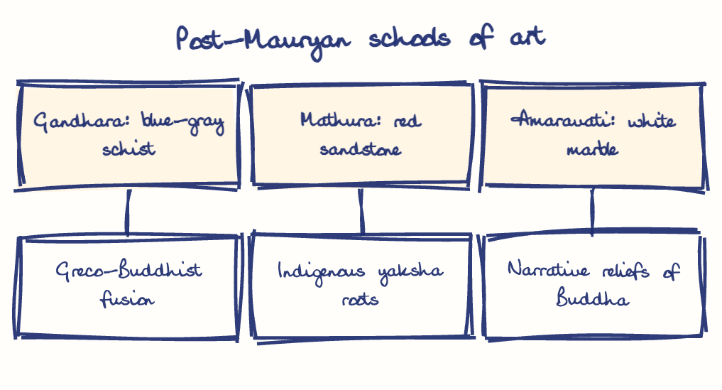
Post-Mauryan art flourished in three major schools under Kushana, Satavahana and Shunga patronage: Gandhara's Greco-Buddhist realism, Mathura's indigenous red-sandstone symbolism and Amaravati's dynamic marble narrative reliefs. Gandhara used blue-grey schist and Hellenistic drapery, while Amaravati's Buddhist reliefs influenced later South Indian temple art.
Model answer
Ghissu Editorial · Verified 4 Oct 2026 · 269 words
Royal and Religious Patronage
The Satavahanas, Kushanas, and Shungas patronized Buddhist, Hindu, and Jain arts, leading to regional schools such as Amaravati in Andhra Pradesh and Mathura in northern India.
Cultural Synthesis in Gandhara
Influenced by Greek and Roman art, Gandhara used blue-gray schist to create realistic Buddha images with Hellenistic motifs like halos and contrapposto postures. This fusion was facilitated by Kushana Empire’s western connections, blending Western and Indian traditions.
Amaravati’s Narrative Dynamism
Known for intricate white marble reliefs, Amaravati vividly narrated Buddha’s life episodes, earning acclaim as the “aesthetic ideal of India” and influencing South Indian temple art. Its fluidity and emotional expression set a high artistic standard.
Material Decay and Political Decline
Use of perishable materials like stucco and marble exposed to elements, along with the fall of patron dynasties like Satavahanas, led to deterioration and fragmentation of artistic traditions.
Enduring Influence
Despite challenges, these schools influenced later temple architecture in Pallava and Chalukya periods, preserving their iconographic motifs and stylistic elements, demonstrating continuity and adaptation.
Conservation and Awareness
Enhanced restoration using scientific methods and increased funding, along with promotion of regional art histories through research and public programs, can preserve and celebrate these artistic legacies.
This model answer is indicative and the model can make mistakes; please verify key facts independently.
Practise this question
1Get the answer sheet
Sized for this question.
2Write your answer
Timed, by hand.
3Get it marked
Your score and what to fix.
This chapter in the exam
Ancient India - Pre-history, IVC, Vedic, Mauryas, Kushans, Satavahanas, Sangam, Guptas16 questions
Asked in 8 of 8 sittings since 2008
Most tested: Harappan civilisation—urban planning, origin/decline, and continuity.
- 2025Discuss the origin and expansion of the Indus Valley Civilization.
- 2025Briefly analyze the teachings of Buddha and Mahavira.
All 16 questions, sorted by sub-topic, with model answers and practice.
Question from the official APPSC Group-I Mains 2016 paper. Answer written by Ghissu's engine and checked against our editorial standards. Found an error? Tell us and we correct it within 48 hours.