Analyze the effectiveness of implementation of the Directive Principles of State Policy and suggest ways to improve it.
In short
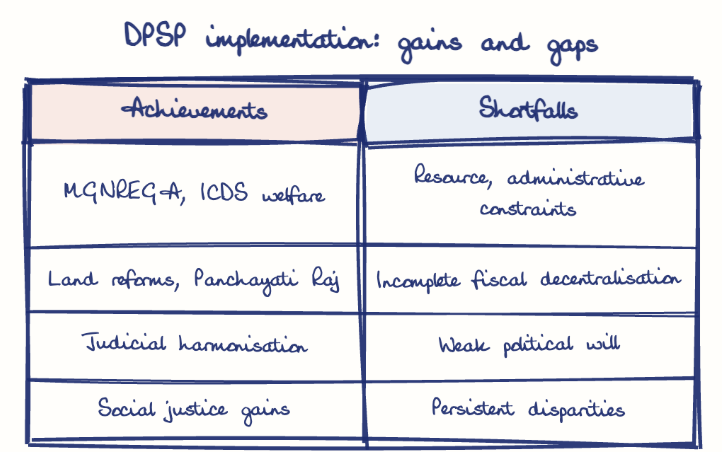
Directive Principles have shaped land reforms, Panchayati Raj, MGNREGA, ICDS and the Right to Education, but implementation remains uneven because of scarce resources, weak administration, incomplete devolution and political will. Stronger fiscal federalism, better monitoring and making key principles justiciable, as with Article 21A, would improve it.
Model answer
Ghissu Editorial · Verified 4 Oct 2026 · 280 words
Welfare Schemes and Social Justice
DPSP inspired MGNREGA, ICDS, and Right to Education; Andhra Pradesh’s ICDS expanded nutrition coverage, supporting Article 47’s goals. Affirmative action aids Scheduled Castes and Tribes, though female labour participation declines. Additionally, judicial pronouncements like the Minerva Mills case have reinforced the importance of DPSP in shaping welfare policies.
Resource and Administrative Deficits
AP CAG 2025 audit revealed gaps in welfare, education, and nutrition schemes, with underutilized funds and poor infrastructure. Fiscal decentralization is weak due to delayed State Finance Commission reports. Moreover, administrative inefficiencies and lack of robust monitoring systems exacerbate implementation shortfalls.
Fiscal Federalism and Governance
Strengthen State Finance Commissions3 and fund transfers to Panchayats for effective local implementation. Ensuring timely and adequate fiscal devolution will empower local bodies to better address socio-economic needs.
Monitoring and Accountability
Use Management Information Systems and audits, as Andhra Pradesh CAG recommends, to improve transparency. Regular evaluation and community participation can enhance service delivery and reduce leakages.
Legal and Political Measures
Increase political commitment, public awareness, and legislate key DPSP as fundamental rights for enforceability. The success of the Right to Education Act as a justiciable right offers a model for other DPSP provisions.
This model answer is indicative and the model can make mistakes; please verify key facts independently.
Practise this question
1Get the answer sheet
Sized for this question.
2Write your answer
Timed, by hand.
3Get it marked
Your score and what to fix.
This chapter in the exam
Indian Constitution, Fundamental Rights, DPSP and Union-State functions18 questions
Asked in 8 of 8 sittings since 2008
Most tested: Rights, social justice, and constitutional safeguards for disadvantaged groups.
- 2025The Indian Constitution favours a federal type of government. Considering this, what duties does the Constitution place on State Governments to ensure the smooth functioning of the nation?
- 2025The Constitution of India grants certain rights to citizens and also provides measures to safeguard them. What are the key constitutional arrangements to ensure the protection of these rights?
All 18 questions, sorted by sub-topic, with model answers and practice.
Question from the official APPSC Group-I Mains 2016 paper. Answer written by Ghissu's engine and checked against our editorial standards. Found an error? Tell us and we correct it within 48 hours.