Explain the concept of minorities with reference to the Indian constitution and the safeguards available for protection of their rights.
In short
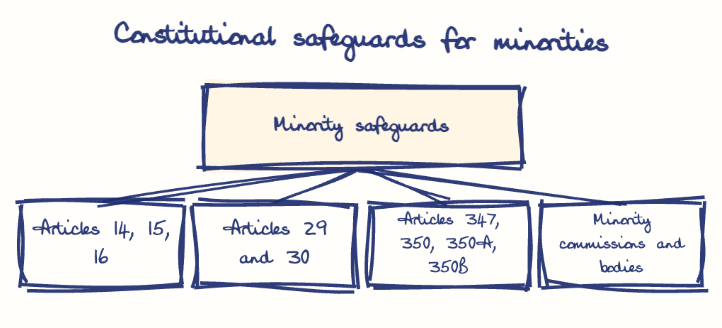
The Constitution does not define minorities but recognises religious and linguistic minorities, determined state by state, and safeguards them through Articles 14-16, cultural and educational rights under Articles 29 and 30, and linguistic provisions in Articles 347-350B. The National Commission for Minorities Act, 1992 notifies six religious minority communities.
Model answer
Ghissu Editorial · Verified 4 Oct 2026 · 279 words
Minority Identification
The National Commission for Minorities Act, 1992, notifies six religious minorities: Muslims, Christians, Sikhs, Buddhists, Parsis and Jains. Linguistic minorities are identified state-wise as per the Supreme Court’s T.M.A. Pai Foundation ruling, which clarified that minority status is determined at the state level, not nationally.
Key Constitutional Articles
Articles 14, 15, and 16 guarantee equality before the law and prohibit discrimination on grounds including religion and language. Articles 29 and 30 protect cultural and educational rights, allowing minorities to conserve their language, script, and culture, and to establish and administer educational institutions. Articles 347, 350, 350A, and 350B safeguard linguistic minorities, including the appointment of a Special Officer for Linguistic Minorities to monitor their interests.
State-Specific Minority Status
Minority identity1 varies by state, e.g., Muslims are minorities nationally but Hindus are minorities in Jammu and Kashmir. Article 341 excludes Christian and Muslim Dalits2 from Scheduled Caste status, limiting their access to affirmative action and highlighting gaps in minority protection.
Institutional Roles and Policies
Strengthening the role of Special Officers for Linguistic Minorities and state commissions can improve monitoring. Promoting inclusive reservation policies that address intra-minority inequalities and raising legal awareness among minorities will enhance rights enforcement and social inclusion.
This model answer is indicative and the model can make mistakes; please verify key facts independently.
Practise this question
1Get the answer sheet
Sized for this question.
2Write your answer
Timed, by hand.
3Get it marked
Your score and what to fix.
This chapter in the exam
Indian Constitution, Fundamental Rights, DPSP and Union-State functions18 questions
Asked in 8 of 8 sittings since 2008
Most tested: Rights, social justice, and constitutional safeguards for disadvantaged groups.
- 2025The Indian Constitution favours a federal type of government. Considering this, what duties does the Constitution place on State Governments to ensure the smooth functioning of the nation?
- 2025The Constitution of India grants certain rights to citizens and also provides measures to safeguard them. What are the key constitutional arrangements to ensure the protection of these rights?
All 18 questions, sorted by sub-topic, with model answers and practice.
Question from the official APPSC Group-I Mains 2016 paper. Answer written by Ghissu's engine and checked against our editorial standards. Found an error? Tell us and we correct it within 48 hours.