Analyse the possible reasons for placing ceilings on agricultural holdings. Give two possible disadvantages to the economy due to such ceilings.
In short
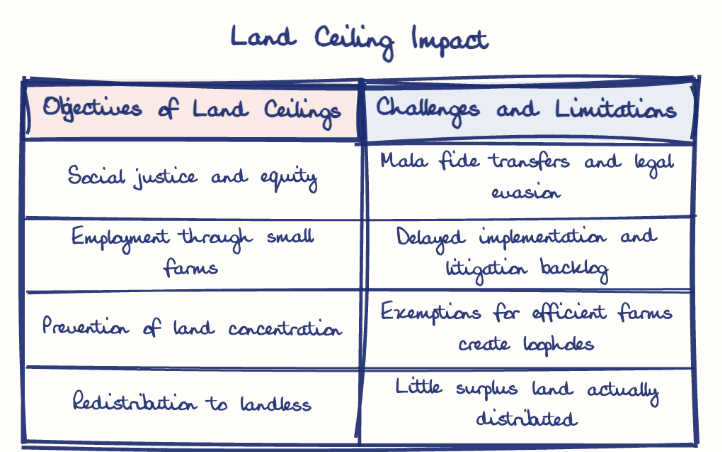
Ceilings on agricultural holdings aim to promote social justice by redistributing surplus land to the landless, create labour-intensive small farms and curb absentee landlordism. Two disadvantages are land markets distorted by benami and mala fide transfers, which deter investment, and fragmented, uneconomic holdings that lose economies of scale.
Model answer
Ghissu Editorial · Verified 4 Oct 2026 · 331 words
Promoting Social Justice
Ceilings reduce land concentration, aiding Scheduled Castes and Tribes, fulfilling constitutional equity goals by redistributing surplus land to landless and marginal farmers, thereby addressing rural income disparities.
Distortion of Land Markets
Mala fide transfers and benami deals are common to evade ceilings, distorting land markets, reducing transparency, and discouraging long-term investments in land improvement and mechanisation critical for productivity.
Limited Surplus Land
Exemptions and delayed enforcement mean actual surplus land available for redistribution is small, limiting the policy’s effectiveness in reducing landlessness and poverty.
Impact in Andhra Pradesh
In Andhra Pradesh, ceiling laws have slowed land consolidation and mechanisation, especially in the drought-prone Rayalaseema region, where fragmented holdings struggle to adopt water-saving technologies and crop diversification, negatively affecting farm incomes.
Digitisation of Land Records
In Andhra Pradesh, comprehensive digitisation can prevent mala fide transfers, improve transparency, and facilitate better enforcement of ceiling laws.
Promote Land Leasing and Consolidation
Encouraging formal land leasing markets and cooperative farming can overcome fragmentation, enabling smallholders to pool resources and adopt capital-intensive, sustainable farming practices.
This model answer is indicative and the model can make mistakes; please verify key facts independently.
Practise this question
1Get the answer sheet
Sized for this question.
2Write your answer
Timed, by hand.
3Get it marked
Your score and what to fix.
This chapter in the exam
Agricultural Development (India)16 questions
Asked in 7 of 8 sittings since 2008
Most tested: Agricultural credit and market regulation/price policy.
- 2025Examine the significance of agriculture finance, production, and marketing in the context of India's agricultural development. Discuss the challenges and opportunities associated with financing agricultural activities, improving production, and developing efficient marketing systems to support sustainable growth in the agricultural sector.
- 2025Explain the role of the Agricultural Produce Market Committee (APMC) Act in Agricultural Price Policy in regulating the agricultural market in India. What are the issues that have been observed by policy makers regarding the functioning of the APMC Act?
All 16 questions, sorted by sub-topic, with model answers and practice.
Question from the official APPSC Group-I Mains 2016 paper. Answer written by Ghissu's engine and checked against our editorial standards. Found an error? Tell us and we correct it within 48 hours.