Describe the highlights of Fiscal Reforms and Budget Management Act 2003.
In short
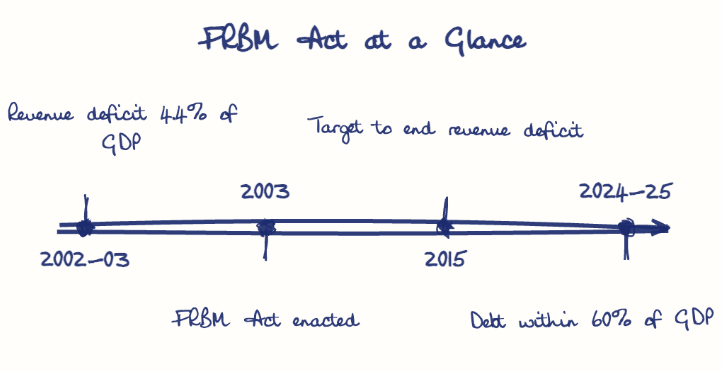
The FRBM Act, 2003 institutionalised fiscal discipline through deficit targets, a ban on direct RBI borrowing, three annual fiscal statements to Parliament and an emergency escape clause. It targeted a 3% fiscal deficit by March 2008, and the 2018 amendment capped general government debt at 60% of GDP.
Model answer
Ghissu Editorial · Verified 4 Oct 2026 · 281 words
Macroeconomic Stability and Equity
The Act aims to maintain fiscal stability, limit borrowing to protect future generations, and enhance transparency via mandatory fiscal statements to Parliament.
Deficit and Debt Limits
Targets included eliminating revenue deficit by 2008 with annual reductions (0.5% revenue, 0.3% fiscal deficit) and a fiscal deficit of 3% of GDP, while the 2018 amendment capped general government debt at 60% of GDP by 2024-25.
Exceptional Clause
Allows exceeding targets only for national security, war, calamities, or severe agricultural distress.
Transparency and Oversight
Annual Fiscal Policy Strategy, Medium-Term Fiscal Policy, and Macro-Economic Framework Statements enable legislative scrutiny.
RBI Financing Ban and Reviews
Prohibits direct RBI financing except Ways and Means Advances; mandates quarterly fiscal reviews; states like Andhra Pradesh have enacted similar laws but face ₹968 Cr excess payments and ₹2,772 Cr outstanding revenue audit observations.
Enhance Transparency and Technology
Improve real-time fiscal data and audits, leveraging reforms like the Income Tax Act, 2025, and schemes such as Ujjwal Discom Assurance Yojana6 (UDAY) for better fiscal governance.
Strengthen Legislative Oversight
Empower state legislatures with resources to scrutinize budgets, aligning with NITI Aayog’s Fiscal Health Index7 and Debt Consolidation and Relief Facility (DCRF).
This model answer is indicative and the model can make mistakes; please verify key facts independently.
Practise this question
1Get the answer sheet
Sized for this question.
2Write your answer
Timed, by hand.
3Get it marked
Your score and what to fix.
This chapter in the exam
Government Budgeting (Union)15 questions
Asked in 6 of 8 sittings since 2008
Most tested: Finance Commission, deficits, and fiscal consolidation in the Indian federal budget system.
- 2025What do you understand by Government Budget? Briefly explain the types of public expenditure and how these expenditures are classified in the government budget.
- 2025Define the term 'deficit' in government finance. Explain the various types of deficits and their economic implications.
All 15 questions, sorted by sub-topic, with model answers and practice.
Question from the official APPSC Group-I Mains 2016 paper. Answer written by Ghissu's engine and checked against our editorial standards. Found an error? Tell us and we correct it within 48 hours.