Describe the strategies being adopted by Andhra Pradesh to achieve the mission on agriculture extension program.
In short
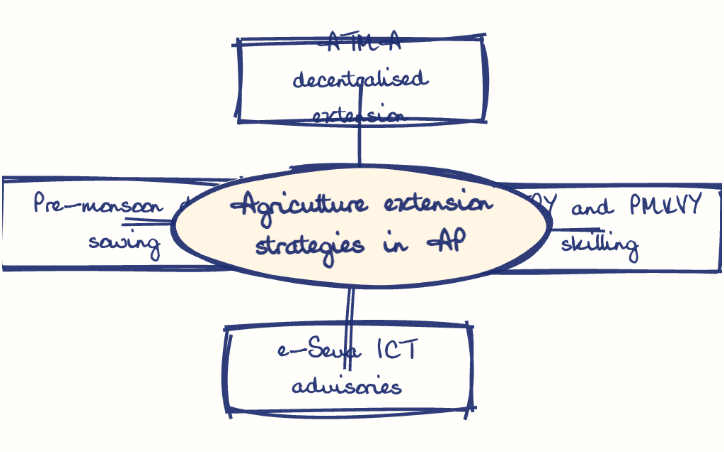
Andhra Pradesh pursues its agriculture extension mission through the decentralised ATMA model, skill training of rural youth under STRY and PMKVY, ICT-based advisory platforms and climate-resilient practices. Its pre-monsoon dry sowing (PMDS) covers nearly 90,000 farmers in over 3,000 gram panchayats, helping them cope with erratic rainfall.
Model answer
Ghissu Editorial · Verified 4 Oct 2026 · 256 words
ATMA Framework for Decentralization
The Agricultural Technology Management Agency2 (ATMA) enables district-level planning and farmer participation; nationally it reached over 1.27 crore farmers by 2025. It facilitates training, demonstrations, and exposure visits tailored to local needs.
Skill Development via STRY and PMKVY
Skill Training of Rural Youth (STRY) and Pradhan Mantri Kaushal Vikas Yojana (PMKVY) train rural youth in agriculture and allied sectors, ensuring employment and strengthening extension outreach. This also helps reduce distress migration by creating local opportunities.
Climate-Resilient Practices
Promotion of pre-monsoon dry sowing (PMDS) covers nearly 90,000 farmers under the state’s natural farming programme, while Neeru-Chettu supports water conservation, addressing water scarcity and climate variability. These practices improve sustainability and resilience against erratic rainfall.
Expand Digital Infrastructure
Strengthen ICT networks and mobile advisory services to reach remote and rainfed areas, ensuring inclusive access to extension services.
Integrate Market Linkages
Link extension with farmer producer organizations (FPOs) and e-NAM to improve farmers’ income realization and market access.
This model answer is indicative and the model can make mistakes; please verify key facts independently.
Practise this question
1Get the answer sheet
Sized for this question.
2Write your answer
Timed, by hand.
3Get it marked
Your score and what to fix.
This chapter in the exam
Agriculture Development in Andhra Pradesh31 questions
Asked in 8 of 8 sittings since 2008
Most tested: Agriculture’s structure, performance, and state policy interventions in Andhra Pradesh.
- 2025Discuss the role of agriculture in the economic development of Andhra Pradesh. How has agriculture contributed to the State Gross Domestic Product (SGDP) in recent years? Identify the key drivers influencing its performance.
- 2025What are the key drivers for the growth of the fisheries sector? What are the schemes undertaken by the fisheries department for the growth of this sector?
All 31 questions, sorted by sub-topic, with model answers and practice.
Question from the official APPSC Group-I Mains 2016 paper. Answer written by Ghissu's engine and checked against our editorial standards. Found an error? Tell us and we correct it within 48 hours.