Discuss the concept of revenue deficit and effective revenue deficit and justify the reasons for introducing effective revenue deficit. Give the details of the expected revenue deficit & the effective revenue deficit by the fiscal 2016-17, as per the Union Budget 2013-14.
In short
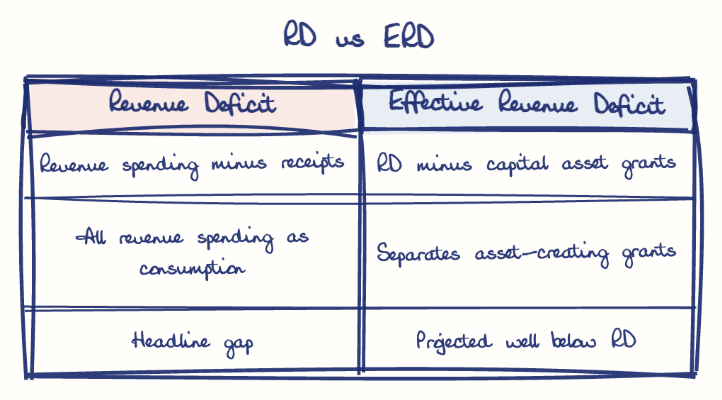
Revenue deficit is the excess of revenue expenditure over revenue receipts, while effective revenue deficit, introduced in the Union Budget 2011-12, excludes capital asset grants, so productive spending is not counted as consumption. Budget 2013-14 projected a revenue deficit of 1.5% of GDP and zero effective revenue deficit by 2016-17.
Model answer
Ghissu Editorial · Verified 4 Oct 2026 · 274 words
Effective Revenue Deficit Introduction
The 2011-12 Union Budget introduced ERD to exclude grants financing capital assets from revenue deficit calculations, recognizing their productive nature and providing a more accurate measure of fiscal health.
Budget 2013-14 Projections
Revenue deficit was expected to fall to 1.5% of GDP by 2016-17, while ERD was projected at 0% due to exclusion of capital grants. This distinction aimed to encourage capital spending without penalizing fiscal metrics, promoting investment-led growth.
State-Level Fiscal Realities
Andhra Pradesh65’s revenue deficit reached ₹33,186 crore (1.8% of GSDP) in 2025-26, with capital expenditure falling sharply to 0.55% of GSDP, highlighting challenges in balancing consumption and investment post-bifurcation (PRS India). This underscores the difficulty states face in managing fiscal discipline alongside development needs.
Enhance Tax Revenue Mobilization
Strengthen tax administration and broaden the tax base in Andhra Pradesh to reduce dependence on borrowing for revenue expenditure and improve fiscal sustainability.
This model answer is indicative and the model can make mistakes; please verify key facts independently.
Practise this question
1Get the answer sheet
Sized for this question.
2Write your answer
Timed, by hand.
3Get it marked
Your score and what to fix.
This chapter in the exam
Government Budgeting (Union)15 questions
Asked in 6 of 8 sittings since 2008
Most tested: Finance Commission, deficits, and fiscal consolidation in the Indian federal budget system.
- 2025What do you understand by Government Budget? Briefly explain the types of public expenditure and how these expenditures are classified in the government budget.
- 2025Define the term 'deficit' in government finance. Explain the various types of deficits and their economic implications.
All 15 questions, sorted by sub-topic, with model answers and practice.
Question from the official APPSC Group-I Mains 2016 paper. Answer written by Ghissu's engine and checked against our editorial standards. Found an error? Tell us and we correct it within 48 hours.