Discuss the performance of agriculture sector during the 11th plan period and reasons for such performance.
In short
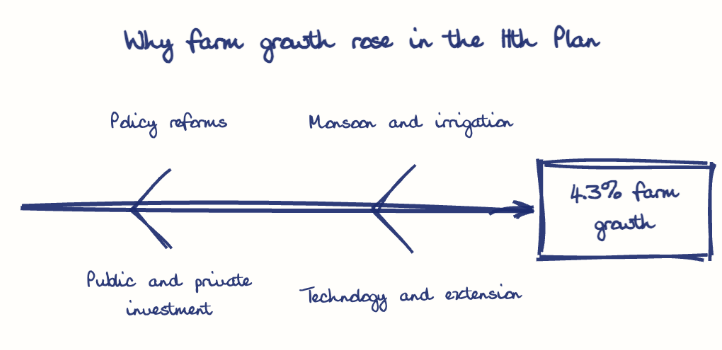
Agriculture performed well in the 11th Plan, with growth near the 4% target versus about 2.5% earlier, driven by RKVY, the National Food Security Mission, renewed public investment, better monsoons and technology. Foodgrain output rose from about 217 million tonnes in 2006-07 to about 259 million tonnes in 2011-12.
Model answer
Ghissu Editorial · Verified 4 Oct 2026 · 282 words
Growth Close to Target
Agriculture grew close to the 4 percent goal, up from about 2.5 percent in the 9th and 10th Plans, supporting overall GDP growth of about 8 percent. This growth was crucial for rural income and poverty reduction.
Production and Diversification
Foodgrain output reached a record of about 259 million tonnes in 2011-12; schemes like National Horticulture Mission and Rashtriya Krishi Vikas Yojana (RKVY) diversified crops and boosted farmer incomes. Allied sectors such as dairy and fisheries also expanded, enhancing nutritional security.
Policy Reforms and Investment
The National Policy on Farmers (2007) and National Commission on Farmers’ recommendations improved credit, insurance, and marketing; public investment in irrigation and credit increased. The Rashtriya Krishi Vikas Yojana incentivized states4 to invest more in agriculture.
Infrastructure and Market Reforms
Complete irrigation projects like Polavaram, expand e-NAM and Farmer Producer Organisations to improve market access and price realization for farmers. Strengthening rural infrastructure remains vital.
This model answer is indicative and the model can make mistakes; please verify key facts independently.
Practise this question
1Get the answer sheet
Sized for this question.
2Write your answer
Timed, by hand.
3Get it marked
Your score and what to fix.
This chapter in the exam
Agriculture Development in Andhra Pradesh31 questions
Asked in 8 of 8 sittings since 2008
Most tested: Agriculture’s structure, performance, and state policy interventions in Andhra Pradesh.
- 2025Discuss the role of agriculture in the economic development of Andhra Pradesh. How has agriculture contributed to the State Gross Domestic Product (SGDP) in recent years? Identify the key drivers influencing its performance.
- 2025What are the key drivers for the growth of the fisheries sector? What are the schemes undertaken by the fisheries department for the growth of this sector?
All 31 questions, sorted by sub-topic, with model answers and practice.
Question from the official APPSC Group-I Mains 2016 paper. Answer written by Ghissu's engine and checked against our editorial standards. Found an error? Tell us and we correct it within 48 hours.