Explain the need for emergence of Regional rural banks, and discuss the problems faced by them and the corresponding revisions made.
In short
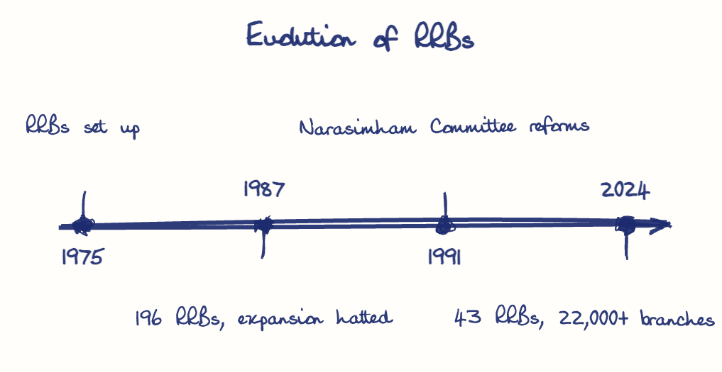
Regional Rural Banks emerged in 1975 to give small farmers, artisans and weaker rural sections affordable institutional credit, but suffered losses from poor recovery, rising wage bills and overlap with sponsor banks. The 1991 Narasimham Committee pushed reforms for viability, including branch rationalisation and allowing all types of banking business.
Model answer
Ghissu Editorial · Verified 4 Oct 2026 · 266 words
Tripartite Ownership
RRBs are jointly owned by Central Government (50%), State Government (15%), and sponsoring banks (35%), ensuring resource pooling and expertise. Their operations are confined to notified districts to focus on rural outreach.
Narasimham Committee Recommendations
The 1991 committee urged rural subsidiaries for commercial banks, rationalisation of branches, and allowing RRBs to undertake all banking activities to boost viability. It emphasized integrating local knowledge with commercial banking strength to improve financial health.
Financial and Operational Issues
RRBs suffer from poor recovery rates, rising wage bills, and overlap with sponsoring banks, leading to inefficiencies and limited rural credit coverage. Only 18.4% of rural populations had savings accounts with Scheduled Commercial Banks including RRBs, indicating persistent inclusion gaps.
Regulatory Reforms and Capacity Building
RBI’s proposed reforms for cooperative and rural banks, including updated prudential norms, along with focused staff training, will improve governance, credit recovery, and product innovation tailored to rural needs.
This model answer is indicative and the model can make mistakes; please verify key facts independently.
Practise this question
1Get the answer sheet
Sized for this question.
2Write your answer
Timed, by hand.
3Get it marked
Your score and what to fix.
This chapter in the exam
Inclusive Growth: India and AP schemes49 questions
Asked in 8 of 8 sittings since 2008
Most tested: Women empowerment and poverty reduction through AP welfare and credit-linked institutions
- 2025Elaborate on the meaning of Inclusive Growth in the context of the Indian economy. Discuss the key strategies and instruments that can be employed to foster greater inclusion and ensure that the benefits of economic growth reach all sections of society.
- 2025Critically Examine the major poverty alleviation and employment generation programmes in India. How effective have they been in addressing rural and urban poverty?
All 49 questions, sorted by sub-topic, with model answers and practice.
Question from the official APPSC Group-I Mains 2016 paper. Answer written by Ghissu's engine and checked against our editorial standards. Found an error? Tell us and we correct it within 48 hours.