Briefly state the salient features of the National Data Sharing and Accessibility Policy, 2012 and its benefits?
In short
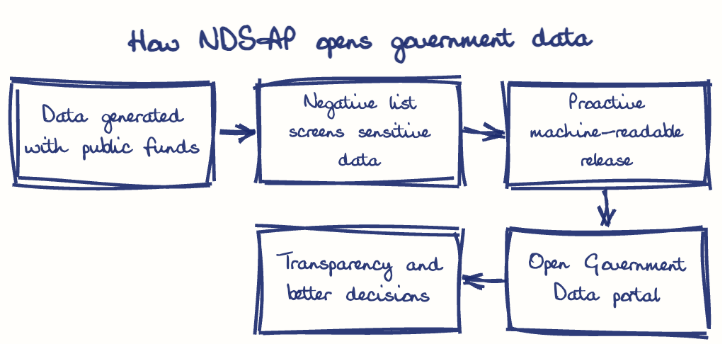
The National Data Sharing and Accessibility Policy 2012 mandates that non-sensitive government data created with public funds be shared in machine-readable form, classified as open, registered or restricted access, with Data Controllers and negative lists. It created the data.gov.in platform, improving transparency, accountability and data-driven innovation.
Model answer
Ghissu Editorial · Verified 4 Oct 2026 · 244 words
Comprehensive Data Sharing Mandate
NDSAP requires all non-sensitive government data funded by public money to be accessible in human and machine-readable formats, promoting transparency nationwide and enabling innovation across sectors.
Institutional Mechanisms
The data.gov.in platform run by NIC and Data Controllers (later Chief Data Officers) in each department coordinate data release and sharing, ensuring standardized practices.
Data Classification and Negative List
It categorizes data as open, registered or restricted access, with a departmental negative list restricting sensitive datasets, to balance openness with privacy and security.
Challenges in Practice
Inter-departmental silos and delays in data dissemination persist across departments at the Centre and in states like Andhra Pradesh, limiting real-time policy impact and transparency.
Strengthen Institutional Capacity
Empower state committees to improve data sharing and governance in Andhra Pradesh, leveraging platforms like the Open Government Data portal to enhance transparency and innovation.
Enhance Privacy Frameworks
Align NDSAP with the Digital Personal Data Protection Act2 and DPDP Rules for robust data protection, addressing concerns raised by incidents like the Cambridge Analytica scandal.
This model answer is indicative and the model can make mistakes; please verify key facts independently.
Practise this question
1Get the answer sheet
Sized for this question.
2Write your answer
Timed, by hand.
3Get it marked
Your score and what to fix.
This chapter in the exam
Science, Technology & Innovation: policies, institutions, achievements20 questions
Asked in 7 of 8 sittings since 2008
Most tested: Science and technology policy and mission-mode institutions
- 2025Evaluate the impact of Internet of Things (IoT) technologies on the automation of household systems. Illustrate how everyday tasks have evolved due to IoT innovations.
- 2025Which are the major scientific institutes located in Andhra Pradesh? Discuss the role of IISER Tirupati in the scientific and educational development of the state.
All 20 questions, sorted by sub-topic, with model answers and practice.
Question from the official APPSC Group-I Mains 2016 paper. Answer written by Ghissu's engine and checked against our editorial standards. Found an error? Tell us and we correct it within 48 hours.